




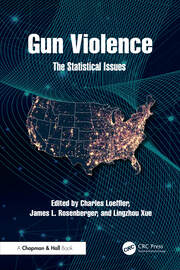
1st Edition
Gun Violence The Statistical Issues
Editor Biographies
List of Contributors
Chapter 1: Nonfatal Firearm Injury Surveillance in the US: An Update
Catherine Barber, Philip J. Cook, and Susan T. Parker
Chapter 2: Police Investigation and Court Processing of Shootings in Durham, NC
Philip J. Cook and Audrey Vila
Chapter 3: Assessing the impact of gunshot detection technology: Methodologies, analytical approaches, and insights
Daniel S. Lawrence and Eric L. Piza
Chapter 4: Measuring and Studying Officer-Involved Shootings in the US: Comparing Estimates from Multiple Open-Source Registries
Justin Nix, Ian Adams, and Joshua McCrain
Chapter 5: On Racial Bias and Fatal Police Shootings: Insights from Publicly Reported Data
Lucas Mentch and Ryan Cecil
Chapter 6: Learning About the Illegal Market for Ammunition through the Lens of Recovered Firearms and Ammunition
Charles E. Loeffler
Chapter 7: Statistical Methods to Estimate the Impact of Gun Policy on Gun Violence
Eli Ben-Michael, Mitchell L. Doucette, Alexander D. McCourt, Avi Feller, and Elizabeth A.
Stuart
Chapter 8: Scaling Hawkes Processes
Seyoon Ko, Jasen Zhang, and Andrew J. Holbrook
Chapter 9: Atlanta Gun Violence Modeling via Nonstationary Spatio- temporal Point Processes
Zheng Dong and Yao Xie
Chapter 10: Changes in the Reproduction Number of Mass Shootings in the United States Following the COVID-19 pandemic
Sarah Oliver, Sarah Penrice, P. Jeffrey Brantingham, Fred Morstatter, George Mohler, and Alex Knorre
Biography
Charles Loeffler is an Associate Professor of Criminology at the University of Pennsylvania, and his research interests include life-course criminology, the effects of criminal justice institutions, and topics at the intersection of crime and technology. He was a First Place Winner of the 2017 National Institute of Justice (NIJ) Real Time Crime Forecasting Competition and was a National Science Foundation/National Bureau of Economic Research Crime Research Fellow. He was the co-organizer of the 2024 Ingram Olkin Statistics Serving Society Forum on "The Statistics of Gun Violence."
James L. Rosenberger is a Professor Emeritus of Statistics at the Pennsylvania State University and the Director Emeritus of the National Institute of Statistical Sciences (NISS), and his research interests include linear models, design and analysis of experiments, bioinformatics, and genomics. He is a Fellow of the American Statistical Association (ASA) and a Fellow of the American Association for the Advancement of Science (AAAS). He was the co-organizer of the Inaugural Ingram Olkin Statistics Serving Society Forum on "Gun Violence: The Statistical Issues" in 2019 and the 2024 Ingram Olkin Statistics Serving Society Forum on "The Statistics of Gun Violence."
Lingzhou Xue is a Professor of Statistics at the Pennsylvania State University, and his research interests include high-dimensional statistics, statistical and machine learning, nonparametric statistics, optimization, and statistical applications in biomedical, environmental, and social sciences. He is a Fellow of the Institute of Mathematical Statistics (IMS), a Fellow of the American Statistical Association (ASA), and an Elected Member of the International Statistical Institute (ISI). He was the co-organizer of the Inaugural Ingram Olkin Statistics Serving Society Forum on "Gun Violence: The Statistical Issues" in 2019 and the 2024 Ingram Olkin Statistics Serving Society Forum on "The Statistics of Gun Violence."
