




List of Figures
Introduction to Gustav Mahler and the Neue Freie Presse
Chapter 1 Mahler and his Symphonies and Songs
Chapter 2 Mahler and the Opera
Chapter 3 Vienna’s Mahler
Chapter 4 Mahler’s Legacy
Epilogue
Index
Biography
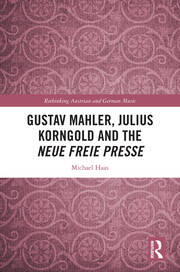
Michael Haas studied piano and composition at Vienna’s Music Academy and Vienna’s Conservatory and received his PhD in 2016 at London Middlesex University. From 1977, he was engaged as a producer at Decca Records working primarily with Sir Georg Solti. In the mid-1980s, he initiated the series “Entartete Musik”, the first retrospective of music lost during the Nazi years. He then moved to Sony Classical where he produced Claudio Abbado and the Berlin Philharmonic before being appointed Vice President at Sony Classical in New York. He returned to Decca Records in 1995. In 2000, Haas worked as a freelance producer and was appointed Director of the Suppressed Music Division at the Jewish Music Institute at SOAS, London University. From 2002–2010 he was Music Curator at Vienna’s Jewish Museum. His books include Forbidden Music – The Jewish Composers Banned by the Nazis (2013) and The Music of Exile (2023). In 2016 he co-founded the Exilarte Center at Vienna’s University of Music and Performing Arts. Over the course of his professional career as recording producer Haas has won many recording prizes including four Grammys.
"This remarkable collection of contemporary reviews and essays relating to Gustav Mahler is a revelation. Not only do we come away with a deep appreciation of the high standards of Viennese music criticism, including one of its preeminent practitioners, Julius Korngold of the Neue Freie Presse, but we gain a new understanding of the nuances and complexities of the Viennese reception of Maher’s activities and legacy as a composer, conductor, and opera administrator. With insightful commentary and valuable background annotations, Michael Haas challenges us to rethink received notions of fin-de-siècle musical modernism, cultural politics, German nationalism, and the ever-pertinent question of antisemitism in an environment in which many of Mahler’s most ardent critics (and champions) were themselves Jewish. A most welcome addition to the literature."
Christopher Hailey, Director, Franz Schreker Foundation
"Frequently seen as a victim of anti-Semitic criticism in the Vienna of his day, Mahler’s later reputation actually owed much to Jewish criticism of the period, above all to that of the influential Julius Korngold. In giving us access to this fascinating writer (father of the ultimately more famous composer) and others of his contemporaries, Michael Haas provides invaluable access to a rich field of criticism not otherwise readily available to the non-German reader."
Peter Franklin, Emeritus Fellow, University of Oxford
"Haas's efforts have produced a volume which opens a window into Mahler's professional life in Vienna and the characters which populated it that we've never had before. This is a hugely important contribution to Mahler scholarship as it offers a far more nuanced, balanced and detailed picture of Mahler's years in Vienna."
Kenneth Woods
“Overall, the book is innovative on three levels. Firstly, it is extremely valuable as a source edition, because Korngold's writings have hitherto been scattered, partly inaccessible, and now they are available in English, with careful editing. Secondly, it places Mahler's cultural representation in a new framework, since it does not repeat the composer's "artistic greatness", but presents its public construction. Thirdly, it offers an analysis of the intersections of Viennese assimilation, bourgeois publicity and modern music criticism that has hitherto been lacking in the literature. Haas's work is therefore not a simple Mahler book, nor is it a Korngold monograph. Rather, it is an examination of the cultural ecology of Viennese modernity: an exploration of how aesthetic, social, ideological and identity structures are linked in the discourse around a composer. The intellectual power of the volume lies in the fact that it does not want to close everything, to explain it definitively: rather, it shows that Mahler can also be read as an allegory – as an allegory of the tensions, dilemmas and aesthetic aspirations of modernity. That is why the book is one of the important contributions not only to Mahler research, but also to 20th-century art and cultural studies in general.’
Ujvári Hedvig, Alföld, 2025
