




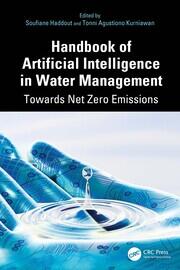
1st Edition
Handbook of Artificial Intelligence in Water Management Towards Net Zero Emissions
Introduction: Understanding Artificial Intelligence
Part I: Water Quality and Resource Management
1. SDG and Water: Artificial Intelligence Nexus.
Saithala Mounika, BB Nayak, M Ramesh Naik, and Bhargavi
2. Urban Water Management Challenges and Solutions.
Yi Ka Fong, Hong Yee Kek, Huiyi Tan, Mohd Hafiz Dzarfan Othman, Sien Jie Wong, Mohamad Nur Hidayat Mat, Yoon Tung Chan, and Keng Yinn Wong
3. Machine Learning, IoT, and GIS for Water Quality Monitoring.
Huiyi Tan, Mohd Hafiz Dzarfan Othman, Fong Chi Chan, Hong Yee Kek, Kok Sin Woon, Ruzairi Abdul Rahim, Sien Jie Wong, Elmy Johana Mohamad, and Keng Yinn Wong
4. Advantages and Challenges of AI-Driven Water Quality Monitoring.
Jerome P. Romero, Liliane M. Suarez, Joan Cecilia C. Casila, and Eric B. Casila
5. Artificial Intelligence in Water Resource Management.
Durgam Venkatesh, Gaini Sairam, Gandi Rupa, C Sudha Rani, C Sudhakar, and T Rajeshwar Reddy
6. Water Management in the Context of Net Zero Emissions.
Sherwin P. De Jesus, Claudette Joyce B. Mendina, and Joan Cecilia C. Casila
7. Artificial Intelligence for Global Water Security and Management.
Saikat Biswas, Pritha Kundu, and Rupa Das
8. Smart Water Infrastructure.
Chunchu Suchith Kumar, Neroju Manasa, Guda Bhargavi, and Arunabha Pal
Part II: Applications in Agriculture
9. Smart Technologies to Achieve Net Zero Emissions in Food Production Systems.
Joan Cecilia C. Casila, Kanta Kobayashi, Joseph Conrad M. Li, and Eric Jay F. Bulalacao
10. AI-Integration for Irrigation Optimization.
Tri Retnaningsih Soeprobowati and Ovide Decroly Wisnu Ardhi
11. Precision Agriculture and Water Efficiency: Predictive Analytics, Irrigation Scheduling, and Weather Forecasting Models.
Suresh Babu, Bhargavi G, B B Nayak, and Suchith Kumar
Part III: Climate Action and Conservation
12. Aquatic Ecosystem Preservation using Artificial Intelligence.
Doaa A. El-Emam and Menna A. Shata
13. Artificial Intelligence and Water Conservation.
Thulisekari Prasanna, G.Bhargavi, and Burra Shyamsunder
14. Floodplain Width Prediction in Flood Disaster Management.
Mohammad Uzair Anwar Qureshi, Isa Ebtehaj, and Hossein Bonakdari
15. K-Means Clustering: Geometric Design of Double-Arch Dams.
Enrico Zacchei and José Luis Molina
16. Water Security in a Changing World: Harnessing AI to Mitigate Climate Change Impacts.
Joan Cecilia C. Casila, Luisito C. Abueg, Liliane M. Suarez, Sherwin P. De Jesus, Claudette Joyce B. Mendina, and Jerome P. Romero
17. Building Climate-Resilient Water Systems: Challenges, Solutions, and AI-Driven Strategies.
Doaa A. El-Emam
18. Future Trends and Emerging Technologies in the Integration of AI and Water Management.
Soufiane Haddout and Tonni Agustiono Kurniawan
Conclusion
Biography
Dr. Soufiane Haddout is a researcher in the Department of Physics, Faculty of Science, Ibn Tofail University, Morocco. He is the author of 3 books, over 60 refereed journal articles with 40 refereed articles as the first author. He is involved in collaborative research with 22 universities/institutions worldwide, serves as an expert reviewer with AEIC-Academic Exchange Information Centre (China), and he is a reviewer for many project proposals from international universities. He has received more than 100 certificates from international conferences and renowned journals and been a Keynote/invited speaker and Technical Committee member for numerous international conferences. He is the Co-Chair of the scientific session of the International Conference of Coastal and Estuarine Research Federation USA; 1st and 2nd International Conference on Climate Change and Ocean Renewable Energy; and Chair of the scientific session of the 16th International Conference on Computer and Electrical Engineering (ICCEE 2023).
Dr. Tonni Agustiono Kurniawan is an Associate Professor at Xiamen University, China. He is a recognized global leader in tackling complex environmental problems that have significant societal relevance and positive impact in the world. His research interests are in the areas of wastewater treatment and solid waste management. His degrees include a B.Sc. in chemistry from the Bogor Agricultural University (Indonesia), a M.Sc. in environmental technology from the Thammasat University (Thailand), and a Ph.D. in applied chemical technology from the Hong Kong Polytechnic University (China). Dr. Kurniawan has authored an extensive body of work comprising over 218 peer-reviewed journal publications, 26 conference proceedings, 14 book chapters, and 12 monographs in waste to energy and wastewater treatment. Dr. Kurniawan received the 2010 Green Talent Award from German Federal Ministry of Education and Research (BMBF), the 2013 Young Scientist Award from the World Economy Forum (WEF) (Switzerland), and the 2014 Scope-Zhongyu (France) for his outstanding research contribution to the fields of study.
