




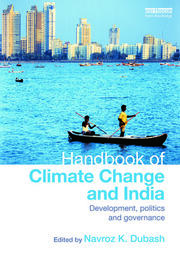

1st Edition
Handbook of Climate Change and India Development, Politics and Governance
Part 1: Climate Science and Potential Impacts Part 2: Past as Prologue: Early Indian Perspectives on Climate Change Part 3: The International Climate Negotiations: Stakes, Debates and Dilemmas Part 4: Domestic Politics of Climate Change Part 5: Integrating Climate Change and Development: A Sectoral View Part 6: Looking into the Future
Biography
Navroz K. Dubash is a Senior Fellow at the Centre for Policy Research, New Delhi.
His current work examines climate change as a problem of multi-level governance by
focusing on domestic regulatory changes in environmentally-sensitive sectors. He also
works on the political economy of energy in India and Asia, international climate
change negotiations, the role of civil society in global environmental governance, and
water governance. He is currently a member of India’s Expert Committee on Low
Carbon Strategies for Inclusive Growth, a lead author for the Fifth Assessment Report
of the Intergovernmental Panel on Climate Change, and he also serves on the editorial
boards of several international journals.
His recent publications include a co-edited special issue of Climate Policy entitled
‘Beyond Copenhagen’ and a co-edited special issue on Global Energy Governance for
the journal Global Policy He has a long history of engagement with civil society
organizations, including as the first international coordinator of the Climate Action
Network, from 1990–92.
Navroz holds PhD and MA degrees in Energy and Resources from the University of
California, Berkeley, and an AB in Public and International Affairs from Princeton
University.
'An excellent handbook, which brings together so many views and perspectives from India…Importantly, it adds Indian voices to the global discussion, which has so far, seen only a smattering of voices from the South.... the handbook will play an important role in bridging some of the gaps in understanding that exist both within India and within the international community.’Jairam Ramesh, Minister, Rural Development, and Former Minister, Environment and Forests, Government of India
'The breadth of the subject treated and the depth of analyses render this book an indispensable tool for anyone working on climate change issues anywhere'.- Youba Sokona, United Nations Economic Commission for Africa (UNECA), Ethiopia
'This is a great volume, valuable not only to the debate in India but globally. Twenty years of climate diplomacy have taught us the central importance of understanding the domestic context that lies behind countries’ international positions; and also of domestic audiences understanding the impact of these positions internationally. This volume offers wide-ranging insights into both. It is the most comprehensive book yet to chart and explain the rise of climate change debates in the world’s most populous country – or indeed, in any of the major emerging economies. The Indian approach to climate change has consequences for all its citizens, and the world beyond: this is the book they need to read.' - Michael Grubb, University of Cambridge, UK
