




1st Edition
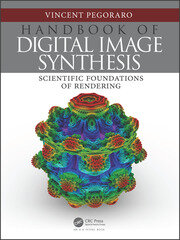
Handbook of Digital Image Synthesis Scientific Foundations of Rendering
Chapter 1 Introduction.
Chapter 2 Elementary Algebra & Calculus.
Chapter 3 Linear Algebra.
Chapter 4 Monte Carlo Methods.
Chapter 5Signal Theory.
Chapter 6 Analytic Surfaces.
Chapter 7 Implicit Surfaces.
Chapter 8 Parametric Curves & Surfaces.
Chapter 9 Indexing Structures.
Chapter 10 Visible Light.
Chapter 11 Participating Media.
Chapter 12 Surface Reflectance.
Chapter 13 Light Transport.
Chapter 14 Analytic Methods.
Chapter 15 Deterministic Methods.
Chapter 16 Stochastic Methods.
Chapter 17 Statistic Methods.
Chapter 18 Image-Forming Optical Systems.
Chapter 19 Visual Perception.
Chapter 20 Color Science.
Chapter 21 HDR Imaging.
Biography
Vincent Pegoraro is a scientific author whose research interests lie in physically-based rendering, on which he has published scholarly articles in the fields of both graphics and visualization. He completed his post-doctoral fellowship at Saarland University, with the Multimodal Computing and Interaction(M2CI) Cluster of Excellence and the Intel Visual Computing Institute VCI). Dr. Pegoraro earned a PhD degree in computer science from the University of Utah, where he carried out research at the Scientific Computing and Imaging (SCI) Institute, and interned within the R&D department of Lucasfilm - Industrial Light & Magic (ILM). Before his doctorate, he worked on virtual simulators as an engineer at the Center for Integration of Medicine & Innovative Technology (CIMIT) and as an intern at LIFL/INRIA.
