




1st Edition
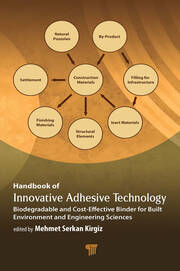
Handbook of Innovative Adhesive Technology Biodegradable and Cost-Effective Binder for Built Environment and Engineering Sciences
1. Starch-based Compound for Eco-friendly and Sustainable Construction Adhesive and Binder System
Mehmet Serkan Kirgiz
2. Self-Compacting Composite Containing Mine Tailing and Fortified by Nanocarbon Dot for Manufacturing of Cost-Effective and CO2-Neutral Material in Construction and Infrastructure
Mehmet Serkan Kirgiz, André G. D. S. Galdino, Ayub Elahi, and Atizaz Ali
3. Valorization of Nano Carbon Dot-Based Green Binder Systems in Terms of Earthquake Engineering, Reinforced Concrete Building, Applied Mechanics, Transportation Engineering, and Their Applications
Mehmet Serkan Kirgiz, André Gustavo de Sousa Galdino, Raul D. S. G. Campilho, Rajesh Kumar, Konstantinos G. Kolovos, and Vinod M. Kumar
4. Some Technological Properties of Hydraulic Construction Lime and Grouting Incorporated with Carbon Nanotube Fiber Chopped for Manufacturing of Cost-Effective and CO2-Neutral Material in a Cleaner Built Environment
Mehmet Serkan Kirgiz, Andre G. D. S. Galdino, John Kinuthia, Raul D. S. G. Campilho, Roberto A. Gonzalez-Lezcano, and Konstantinos G. Kolovos
5. Transforming Oil Sand Waste Ash into Construction Material Using Net-Zero Energy
M. Hesham El Naggar, Mehmet Serkan Kirgiz, André Gustavo de Sousa Galdino, Roberto A. Gonzalez-Lezcano, Raul D. S. G. Campilho, and Konstantinos G. Kolovos
6. Ecological-Sustainable Green Brick Material: Unfired Manufacturing System, Some Features, and Usage for a Greener Built Environment and Construction Technology
John Kinuthia, Mehmet Serkan Kirgiz, André Gustavo de Sousa Galdino, Raul D. S. G. Campilho, Konstantinos G. Kolovos
7. Adhesively Bonded T-Joint Optimization by Cohesive Models: Effect of Adhered Material, Adhesive Type,
Geometry, and Bonding Technique
J. P. M. Lopes, Raul D. S. G. Campilho, and Mehmet Serkan Kirgiz
8. High-Performance Concrete Made of Seawater and Cured in Seawater to Evaluate Hydration Composition and Porosity with Analysis of SEM, Petrography, and Mercury Porosimetry in the Lack of Freshwater of a Cleaner Built Environment
Erniati Bachtiar, Fatmawaty Rachim, Ritnawati Makbul, Arbain Tata, Muhammad Syarif, Mehmet Serkan Kirgiz, André Gustavo de Sousa Galdino, Konstantinos G. Kolovos, and Andi Yusri
9. Portland Cement and Starch-Based Adhesives: A Comprehensive Review
Konstantinos G. Kolovos and Mehmet Serkan Kirgiz
10. Properties of Innovative and Eco-friendly Pavement and Structural Materials Using Waste Marble Sludge Dust, Rice Husk Ash, Coir Fiber, Starch-Based Binder, and Carbon Quantum Dots
Mehmet Serkan Kirgiz, Jamal Khatib, Muhammed Syarif, Erniati Bachtiar, Olatokunbo M. Ofuyatan, Touhami Tahenni, Krishnaraj Ramaswamy, Ahmed Ashteyat, Ayub Elahi, Khairunisa Muthusamy, and Gideon O. Bamigboye
11. Behavior of Bacterial Strain over Cementless Geopolymer Concrete for Sustainable Development
A. Chithambar Ganesh, M. Vinod Kumar, A. Navya, G. Dasaradha Rami Reddy, S. R. Ragavi, C. Navin Gowtham, and Mehmet Serkan Kirgiz
12. Geopolymer Bricks Using Industrial Wastes to Reduce CO2 Footprint
A. Chithambar Ganesh, R. Mohana, M. Vinod Kumar, V. Prem Kumar, and Mehmet Serkan Kirgiz
13. Natural Rubber Latex-Substituted Bitumen Binder for Road Construction: A Review
Trinity A. Tagbor, Mehmet Serkan Kirgiz, Theresah Osei, Latifatu Mohammed, Ammishaddai Ofori-Nyarko, Festus Mensah, and Samuel Obiri
14. Agro-industrial Supplementary Cementitious Materials for Realizing the Sustainable Development Goals of the UN and Net-Zero CO2 Emission
Ahsan Waqar, Naraindas Bheel, Mehmet Serkan Kirgiz, Muhammad Basit Khan, and Muhammad Shoaib Mansoor
15. Natural Rubber Latex and Its Effects on Some Properties of Bitumen for a Cleaner Built Environment
Theresah Osei, Trinity A. Tagbor, Johannes A. M. Awudza, and Mehmet Serkan Kirgiz
16. Analysis of E-Waste Containing Carbon and Other Components as Composite Material for a Cleaner Built Environment and Realizing UN Sustainable Development Goals
M. Vishnu Priyan, R. Annadurai, Mehmet Serkan Kirgiz, André Gustavo de Sousa Galdino, Raul D. S. G. Campilho, Roberto Alonso González-Lezcano, and Konstantinos G. Kolovos
Biography
Mehmet Serkan Kirgiz is a pro-active, full-time, tenured-track professor at the Academia of ACMCEN, Oregon, USA. He has also been a full professor at various universities in Turkey, UK, and USA. His professional experience includes research and development with Scientific and Technological Research Council of Turkey (TUBITAK), teaching graduate- and postgraduate-level students in international institutions and universities collaboratively, and advising students in their theses since 1998. He has authored 260 peer-reviewed articles, 6 books, and 37 book chapters published in highly reputable SCI journals and Scopus-based publications. He also holds an international patent on cement manufacturing with marble powder and brick powder as farina.
“This book is a state-of-the-art report on adhesive technology for the built environment and engineering sciences. It covers all aspects of adhesive technology with emphasis on valorization of waste. It is written by well-known experts in the field and is very useful for undergraduate and postgraduate students as well as practitioners and established researchers.”
Prof. Said Kenai
University of Blida 1, Algeria
