




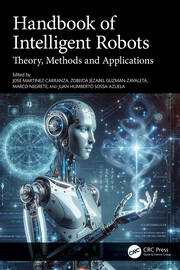
1st Edition
Handbook of Intelligent Robots Theory, Methods and Applications
Part I Theory
1 A Holistic View on Modern Robotics during the Twenty-First Century
Isaac Chairez
2 From Pixels to Perception: The Evolution of Computer Vision in Robotics
Angelica G. Canto-Torrijos1, Zobeida J. Guzman-Zavaleta
3 Perception to Action: Machine Learning Methods for Autonomous Robots
Alejandra Hernandez-Sanchez, Mariel Alfaro-Ponce, Zobeida J. Guzman-Zavaleta
4 Neural Pilots for Agile Flight
Leticia O. Rojas-Perez, Jose Martinez-Carranza
5 Autonomous Drone Navigation Under Low-Light Conditions
Esteban Tlelo-Coyotecatl, Jose Martinez-Carranza, Alejandro Gutierrez-Giles
6 Drone Self-Localization by Reflections of Ego-Noise
Caleb Rascon, François Grondin, Jose Martinez-Carranza
7 Multirate Integration Methods for Multicopters
Gustavo Rodriguez-Gomez, Antonio Matus-Vargas, Jose Martinez-Carranza
8 Trajectory Planning and State Estimation in UAVs
Nilda G. Xolo-Tlapanco, Jose Martinez-Carranza
9 Binary Networks for 6D Aerial Pose Estimation
Aldrich A. Cabrera-Ponce, Manuel Martin-Ortiz, Jose Martinez-Carranza
10 Bayesian Localization of Service Robots
Jesus Savage, Marco Negrete, Yukihiro Minami
11 Classical Walking Algorithms for Humanoids Based on ZMP
Alejandro Aceves-Lopez, Ana P. Islas-Mainou
12 Continual Learning for Robots Deployment in Open-World Environments
Cesar A. Granados-Bernal, Eduardo F. Morales, Jose Martinez-Carranza
13 Ethical Representation of Cultural Aspects in Robots
Ivan V. Meza-Ruiz, Carlos R. Cruz-Mendoza, Mauricio Reyes, Ximena Gutierrez
14 Legal Challenges of Speaking Intelligent Robots:
Intellectual Property and Personal Data Protection in a World of Agentic AI
Israel Cedillo-Lazcano
15 Regulating AI-Powered Robotic Systems in the EU
Mireille M. Sant
Part II Applications
16 LA-ELaDroSy: Low-Cost Autonomous Emergency Landing Drone System
Aldo O. Peña-Gamboa, Cesar Martίnez-Torres
17 Immersion and Invariance Control for Vertical Surface Aerial Manipulation
Aaron Lopez-Luna, Jose Martinez-Carranza, Hugo Rodriguez-Cortes
18 Fuzzy-PID Control of a 3-DoF Helicopter
Ponciano J. Escamilla-Ambrosio, Jose Martinez-Carranza
19 Drone Audition Using a Suspended Microphone Array
François Proulxs, L Oyuki Rojas-Perez, Caleb Rascon, Jose Martinez-Carranza, François Grondin
20 CNN-Quantized Based RF Signal Identification for UAV Disaster Navigation
Carlos A. Osorio-Quero, Jose Martinez-Carranza
21 Crash Avoidance for Autonomous Cars Via Probabilistic Logic Counterfactual Reasoning
Hector Aviles, Marco Negrete, Rafael Kiesel, Alberto Reye, Veronica Rodriguez, Ruben Machucho, Gabriel Ramirez, Myriam Pequeño, Ingridh Gracia, Nicolas Luevano, Karelly Rivera, Jose J. Medrano
22 Chicken Swarm Optimization for Enhanced Line Segment Detection in Thermal-Monocular Depth Estimation
Carlos M. Perez, Cesar Martinez-Torres, Jose Martinez-Carranza
23 Deep Neural Networks for Grasp Planning in Domestic Service Robots
German Alday-Salazar, Itzel Gonzalez-Jimenez, Marco Negrete
24 RobExpNet: A Model for Robotic Exploration Based on Map Entropy Minimization
Miguel A. Rojas-Andrade, J. Adrian Rodriguez-Gonzalez, Uriel H. Hernandez-Belmonte, Angel Diaz-Pacheco, Juan-Pablo Ramirez-Paredes
25 Mapless Navigation in Domestic Service Robots Using Deep Neural Networks
Daniel Vanegas, Marco Negrete, Sergio Alvarado, Jesus Savage
26 Symbolic Fusion in Visual SLAM: A Hidden Markov Model Approach
Oscar Fuentes, Jesus Savage, Marco Negrete
Biography
Dr. Jose Martinez-Carranza is a Senior Researcher C (Equivalent to Full Professor) in the Computer Sciences Department at INAOE. In 2015, he received the Royal Society Newton Advanced Fellowship distinction, awarded by the Newton Fund. His team, QuetzalC++, has participated in highly prestigious international competitions, winning various awards, notably 1st Place in the IROS 2017 Autonomous Drone Racing competition, 1st Place Regional (Latin America) of the OpenCV AI Competition 2021, and ranked 10th in the A2RL Abu Dhabi Drone Racing Competition 2025. He has published 150 articles in scientific journals, book chapters, and international conference proceedings. He served as President of the Mexican Robotics Federation (2024-2025).
Dr. Zobeida Jezabel Guzman-Zavaleta is the Managing Director of the Doctorate Department at the Universidad de las Americas Puebla (UDLAP) in Mexico. She also oversees the institutional STEM strategy and leads the Artificial Intelligence research group at UDLAP. Dr. Guzma´n holds a PhD and a master’s degree in science with a specialization in Computational Sciences from the Institute of Astrophysics, Optics, and Electronics (INAOE), as well as a Bachelor’s degree in Computer Science from the Benemérita Universidad Auto´noma de Puebla (BUAP). In 2023, she coordinated the PhD in Intelligent Systems program at UDLAP (SNP-CONAHCYT) and has been a full-time professor at the university since 2019. Her research focuses on advancing cutting-edge techniques in computer vision, machine learning, deep learning, processing digital images, video, and audio, and steganography and watermarking for data security and concealment.
Dr. Marco Antonio Negrete-Villanueva is currently an Associate Professor at UNAM, and a member of the Board of Directors of theMexican Robotics Federation and Head of the Signal Processing Department at the School of Engineering, UNAM. He holds a PhD in Computer Science and a Master’sdegree in Automatic Control from the National Autonomous University of Mexico. Dr. Marco Negrete has worked on mobile robots focusing on autonomous navigation, movement planning, computer vision and manipulation. He has participated in several international competitions with humanoid and domestic service robots. His interests also include automatic control,self-driving cars and behavioral sciences.
Dr. Humberto Sossa-Azuela is a full-time professor at the National Polytechnic Institute of Mexico and serves as the Director of the Centre for Research in Computing. He is an Emeritus Member of the National System of Researchers, member of the Mexican Academy of Sciences, the Academy of Engineering and Fellow of the Mexican Society for Artificial Intelligence. He has a PhD in Computer Science from the National Polytechnic Institute of Grenoble, France. In addition, He has been distinguished with several awards and distinctions, for instance, the National Computing Prize by the Mexican Academy of Computing (AMEXCOMP), as well as the National Prize from the Cuban Academy of Sciences in the field of Natural and Exact Sciences. In 2024, he was bestowed an Honorary Doctorate by the Technological Institute of Higher Education in Ecatepec. Dr Sossa is the author of five textbooks, holds 13 patents, 32 copyrights, and has published over 490 conference and journal papers. His research areas include Artificial Intelligence, Machine Learning, Artificial Neural Networks, Image Analysis, Pattern Recognition, Robotics, and Metaverses.
