





1st Edition
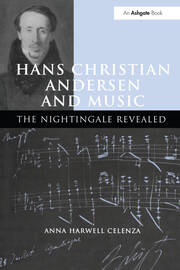
Hans Christian Andersen and Music The Nightingale Revealed
By Anna Harwell Celenza
Copyright 2005
282 Pages
by
Routledge
282 Pages
by
Routledge
282 Pages
by
Routledge
Also available as eBook on:
Hans Christian Andersen was the most prominent Danish author of the nineteenth century. Now known primarily for his fairy tales, during his lifetime he was equally famous for his novels, travelogues, poetry, and stage works, and it was through these genres that he most often reflected on the world around him. With the bicentennial of Andersen's birth in 2005, there is still much about the writer... Read more
Contents: Introduction; The nightingale: Interlude 1: an excerpt from Shadow Pictures from a Trip in the Harz Mountains, Switzerland etc. etc. in the Summer of 1831 by H.C. Andersen; The improviser: Interlude 2: Wandering through the Opera Gallery by H.C. Andersen; The virtuoso: Interlude 3: 'Liszt' from A Poet's Bazaar by H.C. Andersen; The poet, the pianist, and the patron: Interlude 4: The Pepperman's Nightcap by H.C. Andersen; The patriot: Interlude 5: Bulwark of the Arts by H.C. Andersen; The tone-poet; Coda: the death of a romantic; Notes; Bibliography; Index.
Biography
Anna Harwell Celenza, Caestecker Professor of Music, Georgetown University, USA
'...[the book's] deeper insights are fascinating. Anna Harwell Celenza paints a scholarly yet vivid picture of this gangling, grotesque, poetically ardent figure, obsessed with the arts since his wretched childhood and struggling unsuccessfully to become singer, actor and even, hopelessly dancer, before discovering his poetic genius... The attraction of this book [...] is not only Andersen himself, but the window his life opens into his incredibly rich era. When Andersen told him about Scandinavian musical life, Wagner responded 'It's as if you have related an entire fairytale from the world of music!' That should be said here too.' BBC Music 'This is a tautly written, readable and fascinating volume, casting new light on familiar figures from start to finish.' Classical Music '... the strength of Celenza's book lies in the way it places Andersen's work in a broader European context... [it] reveals that his work has much to tell us about music and Romantic subjectivity.' Music and Letters
