




1st Edition
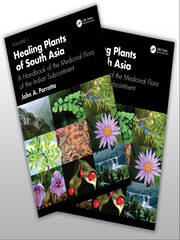
Healing Plants of South Asia A Handbook of the Medicinal Flora of the Indian Subcontinent. Two-volume set
Chapter 1. Introduction: Plant Wealth and Human Health in South Asia
Chapter 2. Pteridophytes (Ferns and Lycophytes)
Chapter 3. Gymnosperms (Conifers, Cycads, Ginkgo, and Gnetophytes)
Chapter 4. Angiosperms (Flowering Plants).
Common Name Indexes (in 31 languages).
Scientific Name Index.
Index of Medicinal Uses.
Biography
John Parrotta, Ph.D., is a forest scientist engaged in research for over 40 years, in Puerto Rico, Brazil, India and other countries worldwide. His areas of interest and expertise include tropical forest ecology, biodiversity conservation, ecology and management of planted forests, forest landscape restoration, forest history, and traditional forest-related knowledge. He is the author of nearly 200 scientific publications, including two books in the fields of traditional forest knowledge and medicinal plants, Healing Plants of Peninsular India (CABI: 2001), and Traditional Forest Knowledge: Sustaining Communities, Ecosystems and Biocultural Diversity (Springer: 2012).
He holds a B.A. in Biology and B.S. in Chemistry from Merrimack College (in Massachusetts, USA), an M.Sc. in Ecology from the University of Aberdeen (Scotland, UK), and a Ph.D. from Yale University. A career scientist and national research program leader for international science issues with the USDA Forest Service, his current work focuses on the conservation, restoration and sustainable management of forests worldwide. Dr. Parrotta also serves as the president (2019-2024) of the International Union of Forest Research Organizations (IUFRO) in which he has held many leadership positions since 1993, He also serves as an editorial board member for several scientific journals, including Restoration Ecology, Ecosystems and People, and Forest Ecology and Management.
“The American Botanical Council’s staff, Board of Trustees, and the ABC Duke Award Committee bestowed the 2026 ABC James A. Duke Excellence in Botanical Literature Award in the reference/technical category to John A. Parrotta’s Healing Plants of South Asia: A Handbook of the Medicinal Flora of the Indian Subcontinent. The Duke Award was created in 2006 to honor the economic botanist, ethnobotanist, author, and ABC co-founding Trustee James A. Duke, PhD. ABC gives the award annually to books that contribute significantly to the medicinal plant-related literature and the fields of botany, taxonomy, ethnobotany, phytomedicine, phytochemistry, and related disciplines. This year, ABC chose Healing Plants of South Asia due to its in-depth, authoritative exploration of the incredible world of Indian flora. ABC truly believes that this book will become a key reference work in this field for years to come.”
“The depth and breadth in Healing Plants of South Asia is a testament to the years of work that went into its compilation. Parrotta has created a reference that includes both codified and folk traditions as well as the names of the plants in the many languages used on the Indian subcontinent. This is a set that will be referenced for years to come.” HerbalGram Associate Editor Hannah Bauman, commenting on the American Botanical Council's 2026 James Duke Award for this book.
"Healing Plants of South Asia will be of value to plant scientists, forestry researchers and professionals, ethnobotanical and ethnomedical researchers, taxonomists, conservationists, community development practitioners, industry, and policy makers, among a host of those involved in the world of medicinal plants and traditional medicine in South Asia." Gerard Bodeker, Green Templeton College, University of Oxford
