




1st Edition
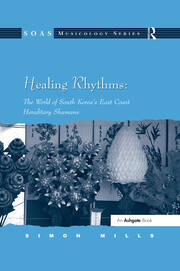
Healing Rhythms: The World of South Korea's East Coast Hereditary Shamans
By Simon Mills
Copyright 2007
134 Pages
by
Routledge
134 Pages
by
Routledge
Also available as eBook on:
Still today, in South Korea, many people pay for the services of mudang - the intermediaries of Korea's syncretic folk religion. The majority of mudang are called to the profession by gods; their clients are individuals or small groups and they focus on the use of spirit-power ('possession') for diagnosis and problem-solving. There is, however, a tiny minority of mudang who are born or adopted... Read more
Contents: Turonggaengi - Who are the East Coast hereditary mudang?; P'unori - Musical practice in ritual; 'Chiokka / Hell song' - The afterlife, gods, ghosts, and belief; Samojang - Learning ritual music; Otch'ongbae - From the past into the future; Conclusion; Bibliography; Index.
Biography
Simon Mills has worked with East Coast hereditary mudang since 1999. He is a teacher of Korean percussion music and occasional lecturer at the School of Oriental and African Studies, University of London, UK.
’... an important addition to the growing body of work in English on Korean Shamanism, contemporary traditional culture, and ritual music.’ Journal of Folklore Research ’The recordings on the CD are fantastic, and could easily have been brought out as an album on their own...’ Bulletin of the School of Oriental and African Studies ’... wonderful...’ Acta Koreana ’The nature of some parts of the book may make them of interest mainly to specialists, but the rest is easily accessible to anybody interested in shamanism and folk religion and therefore eminently useful to comparative religionists.’ Journal of the Royal Asiatic Society ’For the field of ethnomusicology in general, and Korean musicology more centrally, this book heralds the successful synthesis of the study of culture with musical analysis. Mentors’ voices are seamlessly woven into the narrative as a kind of counterpoint to Mills’ own voice and presence, creating the overall effect of an extended conversation between intimate friends. This deep care and respect on Mills’ part is further felt in his balanced and sympathetic account of this Korean belief system and those who embrace it. I have long waited to read about the inner workings of the east coast hereditary shamans, and in this work I have been both satisfied and deeply impressed.’ Ethnomusicology Forum
