



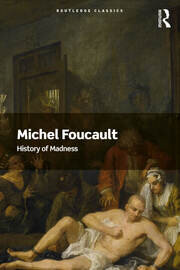

Foreword: History and Significance of Foucault’s History of Madness by Ian Hacking
Introduction by Jean Khalfa
Post scriptum to the Introduction to the Routledge Classics Edition by Jean Khalfa
Preface to the 1961 Edition
Preface to the 1972 Edition
Part 1
I. Stultifera Navis
II. The Great Confinement
III. The Correctional World
IV. Experiences of Madness
V. The Insane
Part 2
Introduction
I. The Madman in the Garden of Species
II. The Transcendence of Delirium
III. Figures of Madness
IV. Doctors and Patients
Part 3
Introduction
I. The Great Fear
II. The New Division
III. The Proper Use of Liberty
IV. Birth of the Asylum
V. The Anthropological Circle
Appendices
I. Madness, the absence of an oeuvre. Appendix I of 1972 edition
II. My body, this paper, this fire. Appendix II of 1972 Edition
III. Reply to Derrida (‘Michel Foucault Derrida e no kaino’. Paideia (Tokyo) February 1972
IV. Madness and Society (‘La Folie et la société’, presented at a Conference at the Faculty of Liberal Arts, Tokyo University, October 1970, a summary of which was published in Todai Kyoyogakubu-ho, 20 Novembre 1970)
Endnotes
Annexes
I. Documents
II. Foucault’s original bibliography
III. Bibliography of English works quoted in this translation
IV. Critical Bibliography on Foucault’s History of Madness.
Index
Biography
Michel Foucault is one of the most influential, and controversial, thinkers of the twentieth century. His engagement with topics such as truth, power and language continues to exert significant influence on a huge range of disciplines, from philosophy, sociology and anthropology to history, politics, law, literature, religion and many others.
Born in Poitiers, France in October 1926, Foucault studied philosophy at the prestigious École Normale Supérieure in Paris, securing degrees in both philosophy and psychology. He lectured there in philosophy and worked as a psychologist at the Höpital Sainte-Anne in the early 1950s. His thesis, Folie et Deraison: Histoire de la folie à l'âge Classique was published in 1961 and subsequently published in English as History of Madness by Routledge. It was hailed as ‘magnificent’ by the renowned historian Fernand Braudel and announced the arrival of a major new voice in philosophy. Several other now famous works followed, including The Birth of the Clinic, The Order of Things and The Archaeology of Knowledge (all published by Routledge).
Foucault was also a renowned activist, campaigning tirelessly on behalf of homosexuals and for prison reform. He travelled to North America in the 1970s and 1980s to live what he termed ‘limit experiences’ and write the three volumes of his History of Sexuality. Fatally ill with AIDS, Foucault died in Paris on 25 June 1984, at the age of fifty-seven.
'…there is a dazzling fluidity of ideas here, not least in underscoring the arbitrariness and fragility of the whole psychiatric enterprise.' - London Review of Books
'...the work of a young genius, a work of masterful accomplishment and prodigious and prodigal energy, grasp and daring. No richer, more multidimensional work of cultural and intellectual history has been written…' - Notre Dame Philosophical Reviews
'…a tremendous resource for all those interested in Foucault’s work and the theorising of madness.' - The Sociological Review
'One of the major works of the twentieth century is finally available in English.' - Paul Rabinow, University of California, Berkeley
'I have no doubt that this long-awaited translation will have a transformative effect on a new generation of readers.' - Nikolas Rose, London School of Economics
Reviews of the French edition:
'This is a quite exceptional book of very high calibre… with a thesis that thoroughly shakes the assumptions of traditional psychiatry.' - R.D. Laing
'Without a shadow of a doubt, the most original, influential and controversial text in this field…' - Roy Porter
