




1st Edition
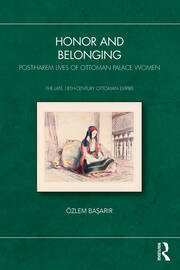
Honor and Belonging Post-Harem Lives of Ottoman Palace Women
Introduction
1 Women in the Ottoman Harem
1.1 The Classical Harem Order
1.2 Status Dynamics of Dynastic Women
1.2.1 Mother of a Prince: The Key to Advancement in the Ottoman Harem
1.2.2 Hanım Sultans: Strategic Actors of Familial Representation
1.2.3 Valide Sultanate: The Pinnacle of Institutional Legitimacy
2 The Spatial Construction of Post-harem Life
2.1 Residences Granted as İhsân-ı Hümâyûn
2.2 Residences Acquired through Independent Purchase
2.3 Rented Residences
2.4 The Household of Dynastic Women: The Service Cadre
3 Economic Sustainability: Income Sources and Financial Strategies of the Ottoman Dynasty Women
3.1 Valide Sultans
3.1.1 Their Ration Allowances
3.1.2 Their Has-Mukataa and Mukataa Revenues
3.2 Imperial Princesses
3.2.1 Their Ration Allowances
3.2.3 Revenues from Their Has Holdings/Has-Malikâne, Malikâne Mukataaas, and Agricultural Estates
3.3 Kadınefendis (Imperial Consorts)
3.3.1 Hadice Ruhşah Kadın (d. 1807)
3.3.2 Nevres Kadın (d. 1797)
3.3.3 Mutebere Kadın (d. 1837)
3.3.4 Mehtabe Kadın (d. 1807)
3.3.5 Binnaz Kadın (d. 1823)
3.3.6 Fâtıma Şebisefa Kadın (d. 1805)
4 Waqf Patronage, Charitable Practices, and the Public Visibility of Ottoman Dynasty Women
4.1 Valide Sultans
4.2 Imperial Princesses
4.3 Kadınefendis (Imperial Consorts)
5 Everyday Life and Consumption of Ottoman Dynasty Women
5.1 Bread
5.2 Meat
5.3 Fat and Oil
5.4 Flour and Flour-Based Products
5.5 Sugar and Salt
5.6 Cereals and Legumes
5.7 Spices
5.8 Milk and Dairy Products
5.9 Beverages
5.10 Offal
5.11 Nuts
5.12 Fruits and Vegetables
5.13 Kitchen Utensils
5.14 Cleaning Supplies
5.15 Animals
5.16 Other Household Expenditures
6 Constructing Dynastic Belonging through Death: Funeral Rituals and the Disposition of Wealth
7 Conclusion
Appendix 1: Seal of Ruhşah Kadın
Appendix 2: Copy of the Deed of Endowment (Vakfiye) of the Nevres Kadın Vakf
Appendix 3: Nevres Kadın’s Regular Kitchen Expenses (Monthly–Annual)
Appendix 4: Seal of Mehtabe Kadın
Appendix 5: The Certificate of Pledge (Temessük) and Seal of Binnaz Kadın’s Jewelry
References
Index
Biography
Özlem Başarır is an Associate Professor of Ottoman History at Inonu University, Türkiye. Her research centers on the fiscal and administrative structures of the Ottoman Empire, with a particular emphasis on the transformation of provincial governance, financial practices, and the visibility of women in economic life. She specializes in the study of eighteenth- and early nineteenth-century Ottoman provincial administration, exploring how mechanisms of taxation, property management, and local authority reflected broader shifts in imperial order. Her publications examine topics such as the reorganization of provincial fiscal systems, the management of mukataa and iltizam revenues, and the role of voivodas, defterdars, and sarrafs in the empire’s evolving bureaucratic hierarchy. She is also the author of Ottoman Dynastic Daughters and Their Incomes (The Eighteenth Century and the First Quarter of the Nineteenth Century) (in Turkish), Kriter, 2018, which investigates the financial networks and property portfolios of Ottoman imperial women. Her current work continues to analyze the intersections of gender, economy, and governance, highlighting the ways in which Ottoman women contributed to the fiscal and symbolic reproduction of dynastic power.
