




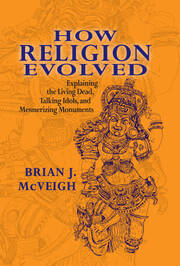
1st Edition
How Religion Evolved Explaining the Living Dead, Talking Idols, and Mesmerizing Monuments
Contents
Foreword by Marcel Kuijsten
Acknowledgments
Prologue: Chasing Ghosts in Tokyo
Part I: The World According to the Gods
1 The Failure of Science to Explain Religion
2 Why the Gods Began to Speak
3 Divine Voices and Visions as Social Adaptation
Part II: When the Gods Spoke and Walked among Us
4 The Living Dead: Explaining Entombment and Ancestor Worship
5 Towns as the Domain of the Gods
6 Temples as Relay Stations: Transmitting Divine Commands
7 Talking Idols: Tools of Divine Control
8 Mortuary Monuments: How the Gods Awed Their Followers
9 Heavenly Ambassadors: God–Kings and Sacred Rulers
10 Ancient Civilizations as God-Governed
11 Mesoamerica: Theocentric Civilizations of the New World
12 Trimming the Theological Tree: Monotheism as Adaptation
13 Angels, Divine Messengers, and Swarms of Demons
Part III: When the Gods Fell Silent
14 Prayers, Possessions, and Prophecies: Conjuring Up the Missing Gods
15 The Gods Depart: The Late-Bronze-Period Dark Ages
16 A Change of Mind in the Ancient World
17 The Axial Age: The World Reborn without Gods
18 Imagining the Transcendent: A New Cognitive Ability
19 Introcosm: A New World of Space and Time
20 The Self Replaces the Gods
21 From Revelation to Reasoning
22 When the Gods Still Whisper: Strange Behaviors Explained
Epilogue: Science and Politics as Neo-Religion
Appendices and Supplementary Charts
A How to Chase Ghosts
B Explaining Religion versus Explaining Religion Away
C Gods on the Brain: Neurotheology
D The Problem with "Cultural Evolution"
E Six Hypotheses of Jaynesian Psychology
F The Limitations of Evolutionary Psychology
G Prehistoric and Historic Mentalities in Perspective
H Predictable Objections, Rebuttals, and Qualifications
I Verification and Applications of Jaynes's Theories
J Primitive Psychopolitics and Neurocultural Adaptation
K A History of Mentalities
L Population Size of Ancient Towns and Cities
M Dreams: A Form of Conscious Interiority
N Pre-Axial and Axial Ages Compared
O Solving the Mystery of Hallucinations
P Autoscopy: Seeing One's Double
Q What the Gods Can Teach Us: A New Understanding of the Mind
Timelines of Mentalities
Explanation
1 Three Major Shifts in Human Mentality
2 Prehistoric Mentalities
3 Middle East
4 Africa
5 Europe
6 South Asia
7 East Asia
8 Southeast Asia
9 Oceania
10 North America
11 South America
12 Mesoamerica
Glossary
References
Index
Biography
Brian McVeigh
