




1st Edition
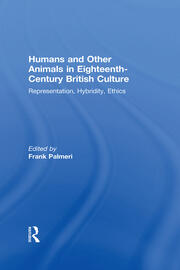
Humans and Other Animals in Eighteenth-Century British Culture Representation, Hybridity, Ethics
Edited By Frank Palmeri
Copyright 2006
248 Pages
by
Routledge
248 Pages
by
Routledge
248 Pages
by
Routledge
Also available as eBook on:
Combining historical and interpretive work, this collection examines changing perceptions of and relations between human and nonhuman animals in Britain over the long eighteenth century. Persistent questions concern modes of representing animals and animal-human hybrids, as well as the ethical issues raised by the human uses of other animals. From the animal men of Thomas Rowlandson to the part... Read more
Contents: Introduction: Representation, hybridity, ethics, Frank Palmeri; Gross metempsychosis and Eastern soul, Chi-ming Yang; The Lady and the Lapdog: mixed ethnicity in Constantinople, fashionable pets in Britain, Theresa Braunschneider; Gulliver's Travels and studies of skin color in the Royal Society, Cristina Malcolmson; Gulliver the Houyahoo: Swift, Locke, and the ethics of excessive individualism, Allen Michie; The autocritique of fables, Frank Palmeri; Animal nomenclature: facing other animals, Richard Nash; Man's animal nature: science, art, and satire in Thomas Rowlandson's 'studies in comparative anatomy', Arline Meyer; 'Listen to me': Frankenstein as an appeal to mercy and justice, on behalf of the persecuted animals, Stephanie Rowe; Shelley's great chain of being: from 'blind worms' to 'new-fledged eagles', Lisbeth Chapin; Gulliver and the lives of animals, Jonathan Lamb; Animal, vegetable, mineral: the play of species in Pynchon's Mason & Dixon, Elizabeth Jane Wall Hinds; Bibliography; Index.
Biography
Professor Frank Palmeri is Professor of English at the University of Miami, and author of Satire in Narrative (1990) and Satire, History, Novel: Narrative Forms, 1665-1815 (2003).
'This inspiring and critically sophisticated collection is an important addition to the growing literature on the representation of animals and animal-human relationships. This aspect of eighteenth-century and Romantic-period culture is subjected to well-informed and highly intelligent speculation from many unusual points of view, and readings of works such as Gulliver’s Travels and Frankenstein will be permanently changed by these analyses.' Christine Kenyon-Jones, King’s College London, UK '... a rewarding clutch of studies...' Times Literary Supplement ’... fascinating collection of essays... a valuable resource for scholars and students interested in the broad sweep of topics here, and for those more specifically focussed on particular seventeenth- and eighteenth-century authors.’ Review of English Studies ’... Frank Pameri situates the volume within the interdisciplinary field of animal studies. It would, however, be a shame for those outside this subfield to miss these engaging and provocative essays... These eleven essays detail the intricate tensions between the collective and the specific and between the human and the nonhuman, but they do not stop there. They offer up the boundary that marks human apart from other animals as part of the Enlightnment's classificatory impulse, and in doinfg so, they suggestively place the study of animals in history at the epicenter of a rich body of scholarship. As Palmeri notes, the study of animals has emerged as a subfield of its own, but this is a volume that deserves the attention of a much wider audience.’ Journal of British Studies
