




1st Edition
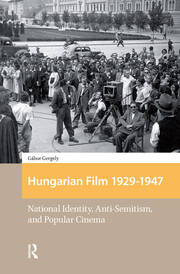
Hungarian Film, 1929-1947 National Identity, Anti-Semitism and Popular Cinema
By Gábor Gergely
Copyright 2017
330 Pages
by
Routledge
330 Pages
by
Routledge
330 Pages
by
Routledge
Also available as eBook on:
What does it mean for someone or something to be Hungarian? People in Hungary grappled with this far-reaching question in the wake of the losses and transformation brought by World War I. Because the period also saw the rise of cinema, audiences, filmmakers, critics, and officials often looked at films with an eye to that question, too. Did the Hungary seen on screen represent the Hungary they... Read more
Introduction, Chapter 1: Key Concepts in Pre-1945 Hungarian Cinema Chapter 2: A Contested Film History Chapter 3: An Industry Emerges 1931-1935 Chapter 4: Boom, Crisis and Anti-Semitic Reorganization 1936-1941 Chapter 5: From War Boom to Bust 1941-1944 Epilogue: Industry Reboot and the Myth of a New Start 1945-1947, Concluding Remarks.
Biography
Gábor Gergely is a lecturer in film studies at the University of Lincoln. He has published articles on Hungarian cinema in the 1930s and 1940s, and a book, >Foreign Devils> (2012), on perceptions of difference in the films of émigré stars in classical Hollywood. More recently, he has published on the MGM Tarzan films of Johnny Weissmuller. He is currently working on the accent, both as a linguistic and as a critical term, in relation to the films and stardom of Arnold Schwarzenegger.
