




1st Edition
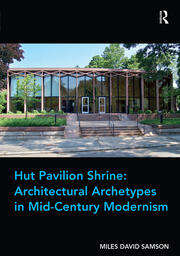
Hut Pavilion Shrine: Architectural Archetypes in Mid-Century Modernism
By Miles David Samson
Copyright 2015
344 Pages
by
Routledge
344 Pages
by
Routledge
344 Pages
by
Routledge
Also available as eBook on:
The phase of American architectural history we call 'mid-century modernism,' 1940-1980, saw the spread of Modern Movement tenets of functionalism, social service and anonymity into mainstream practice. It also saw the spread of their seeming opposites. Temples, arcades, domes, and other traditional types occur in both modernist and traditionalist forms from the 1950s to the 1970s. Hut Pavilion... Read more
Introduction; 1: Pavillon, Cabane, Tabula Rasa; 2: Wright and Mies; 3: Philip Johnson; 4: Modernism, Modernity and Pavilion Typology, 1949–60; 5: Archetype and Order
Biography
Miles David Samson was educated at the University of Chicago and Harvard University. He teaches art history at Worcester Polytechnic Institute. He has held fellowships at the Free University of Berlin and the Buell Center for the Study of American Architecture, Columbia University. His scholarship is in the history of architecture, especially the modern period, in relation to American visual culture. He lives in Franklin, Massachusetts with his wife and son.
’Hut Pavilion Shrine is a much-needed examination of the typologies that shaped postwar American modernism. Dismissed for years as meaningless formalisms, the book is a positive step towards understanding the aesthetic and intellectual content of American architecture after World War II. Further dispelling notions of mere eclecticism, it locates the origins of these typologies deep in architecture’s past. Samson successfully shows how architects previously treated monographically - among them Johnson, Rudolph, Saarinen and Kahn - had much in common intellectually.’ Timothy M. Rohan, University of Massachusetts Amherst, USA and author of The Architecture of Paul Rudolph
