




1st Edition
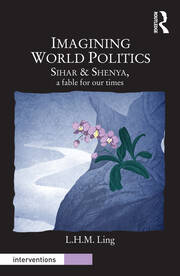
Imagining World Politics Sihar & Shenya, A Fable for Our Times
1. Introduction - Why do we need Sihar & Shenya in IR? 2. Book I: "The Orchid and The Tree" 3. Book II 4. Book III: “The Return.”
Biography
L.H.M. Ling is Associate Dean for Faculty Affairs at the New School for Public Engagement (NSPE) and Associate Professor of International Affairs, The New School. She is also author of The Dao of World Politics: Towards a Post-Westphalian, Worldist International Relations (Routledge, 2014).
In her fabulous way, L.H.M. Ling brings fable, fairy tale, and magical realism into International Relations, and makes of the discipline a set of alternatives to one-dimensional, concrete realism. She has become a master story-teller and this book is both art and scholarship. Stephen Chan, School of oriental & African Studies, UK.
The wonderful thing about this book is that it is not concerned in speaking back to the West. Rather, its stories facilitate an apprehension of thought systems and sensibilities that are other-wise to the provincial vocabulary and imagination of International Relations. Don’t just read it, inhabit it. Robbie Shilliam, Queen Mary, University of London, UK.
At once fairy-tale and feminist/postcolonial critique, this highly unusual book rewards the open-minded reader with a creative new vision for world politics. Roland Bleiker, Professor of International Relations, University of Queensland.
Ling's book is both a provocation and a mindful meditation on the play of wealth, power, love, security and knowledge in politics; it disorients in a good way, suggesting new possibilities for understanding and changing world politics. Neta C. Crawford, Professor of Political Science, Boston University.
