



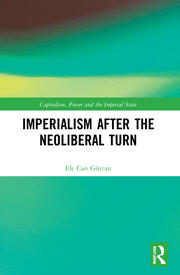

Introduction
1. Imperialism: A Literature Review
2. Economic Imperialism in the Neoliberal Era
3. Imperialism and the Transformation of the Military-Industrial Complex Under Neoliberalism
4. Cultural Imperialism and the Media-Industrial Complex
5. Cultural Imperialism and the Nonprofit-Corporate Complex
6. The Subimperialism Thesis and the BRICS
7. Extractivism and the Latin American Left: The Limits of Anti-Imperialist Discourses
8. "Post-Hegemonic Multipolarity" in Eurasia: Whither the Imperialist System?
Conclusion
Biography
Efe Can Gürcan is the Vice Dean of Research and Development for the Faculty of Economics, Administrative and Social Sciences at İstinye University, Turkey. He also serves as the Director of the Center for Belt and Road Studies at İstinye University and Research Associate at the University of Manitoba’s Geopolitical Economy Research Group. His publications include four books as well as more than 30 articles and book chapters on international development, international conflict and cooperation, and political sociology, with a geographical focus on Latin America and Eurasia. He is author of Multipolarization, South–South Cooperation and the Rise of Post-Hegemonic Governance and co-author of Neoliberalism and the Changing Face of Unionism: The Combined and Uneven Development of Class Capacities in Turkey, Challenging Neoliberalism at Turkey’s Gezi Park: From Private Discontent to Collective Class Action, and COVID-19 and the Future of Capitalism: Postcapitalist Horizons Beyond Neoliberalism.
"Professor Gürcan's work is an extraordinary accomplishment in the field of imperialism theory. It will be indispensable for future scholarship. It unravels the interconnections between imperialism and neoliberalism, representing neoliberalism as a US-led approach to the management of imperialism, one that has failed humanity. With impressive global range, Gürcan analyzes imperialism as a multi-faceted phenomenon that interconnects economic, political and cultural domains."
Oliver Boyd-Barrett, Professor Emeritus of Bowling Green State University (Department of Journalism and Public Relations) and California State Polytechnic University, Pomona, USA (Department of Communication); Author of Media Imperialism and Editor of Media Imperialism: Continuity and Change.
"Exposing the inner-workings of the neoliberal capitalist-imperialist system led by the United States, this book goes to great lengths to highlight the underlying contradictions and conflicts that characterize the fundamental crises of global capitalism in the early 21st century and makes a major contribution to our understanding of imperialism today, while serving as a guide to emerging movements that will take the lead in the struggle to transform the global imperialist system."
Berch Berberoglu, Professor of Sociology and Director, Ozmen Institute for Global Studies, University of Nevada, Reno, USA; Author of Globalization of Capital and the Nation State: Imperialism, Class Struggle, and the State in the Age of Global Capitalism.
"This book offers an excellent analysis of key topics in the contemporary global political economy: neoliberalism, financialisation, globalisation and imperialism. They are examined expertly from the theoretical as well as the historical angle, in the light of case studies and specific experiences. This is an essential work for all those interested in the vectors of international power in today’s world."
Alfredo Saad-Filho, King’s College London, UK; Co-Editor of Neoliberalism: A Critical Reader.
