





1st Edition
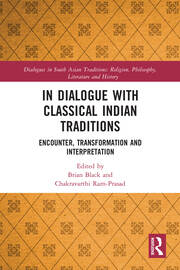
In Dialogue with Classical Indian Traditions Encounter, Transformation and Interpretation
Introduction, Brian Black and Chakravarthi Ram-Prasad Part 1: Encounter 1 Sources of Indian secularism? Dialogues on Politics and Religion in Hindu and Buddhist Traditions, Brian Black 2 Dialogues with Solitary Buddhas, Naomi Appleton 3 Refutation or Dialogue? Śaṃkara’s Treatment of the Bhāgavatas, J.G. Suthren Hirst 4 ‘We Resort to Reason’: The Argumentative Structure in Veṅkatòanātha’s Sesìvaramīmāmòsā, Elisa Freschi 5 ‘Speakers of Highest Truth’: Philosophical Plurilogues About Brahman in the Early Upaniṣads, Jessica Frazier Part 2: Transformation 6 Outer and Inner Dialogues as Transformative Disciplines in the Yogavāsiṣṭha, James Madaio 7 Being Human, Dialogically, Lynn Thomas 8 Dialoguing the Vārkari Tradition, Monika Kirloskar-Steinbach 9 Convincing the King: Jain Ministers and Religious Persuasion through Dialogue, Jonathan Geen Part 3: Interpretation 10 Careful Attention and the Voice of Another, Maria Heim 11 Mahābhārata Dialogues on Dharma and Devotion with Kṛṣṇa and Hanumān, Bruce M. Sullivan 12 Models of Royal Piety in the Mahābhārata: The Case of Vidura, Sanatsujāta and Vidurā, James M. Hegarty 13 Dialogue in Extremis: Vālin in the Vālmīki Rāmāyana, Chakravarthi Ram-Prasad; Afterword, Laurie L. Patton
Biography
Brian Black is Lecturer in Religious Studies in the Department of Politics, Philosophy and Religion at Lancaster University, UK. His research interests include Indian religions, comparative philosophy, the use of dialogue in Indian religious and philosophical texts, and Hindu and Buddhist ethics. He is author of the book The Character of the Self in Ancient India: Priests, Kings, and Women in the Early Upaniṣads.
Chakravarthi Ram-Prasad is Fellow of the British Academy, and Distinguished Professor of Comparative Religion and Philosophy at Lancaster University, UK. He has published several books, including Advaita Metaphysics and Epistemology, Knowledge and Liberation in Classical Indian Thought, and Divine Self, Human Self: The Philosophy of Being in Two Gītā Commentaries. His most recent book is Human Being, Bodily Being: Phenomenology from Classical India.
