




1st Edition
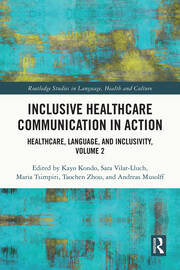
Inclusive Healthcare Communication in Action Healthcare, Language, and Inclusivity, Volume 2
List of Figures
List of Tables
List of Contributors
Introduction
Part I: Scientific and institutional discourses
1. Construing Health and Disability: A diachronic critical corpus assisted investigation of person-first and identity-first language in autism and aphasia
Giulia Bencini and Cinzia Bevitori
2. The inclusion of traditional Chinese medicine in conventional medicine: A move analysis of medical case reports
Jesse W. C. Yip and Kenneth C. C. Kong
3. Power, Agency, and Resilience: Exploring Transgender Experiences within Hong Kong’s Transgender Medical Support System
Kimberly Tao and Simon Chung
Part II: Promoting accessibility and inclusive healthcare
4. “Although I’m glad I kept pushing to get an answer, I really wish I had pushed harder”: Uncovering Affect in cancer patients’ caregivers’ narratives
Miguel-Ángel Benítez-Castro and Jennifer Moreno
5. Making health information more accessible: a report on the OncoTRAD project
Ingrid Cobos López
6. Inclusivity in non-translated and translated English, Spanish, and Catalan health information websites on HIV and Tuberculosis diagnostic testing
Amy Dara Hochberg
7. Machine learning and healthcare discourse research: sample applications
Dennis Tay
Part III: Diverse and inclusive healthcare education practices
8. ‘I’m scared to say because I don’t want people to judge me!’ Coming out in a high school health class
Georgia Carr
9. Graphic Medicine and Community Engagement: Crafting a Doña from the Inland Empire
Covadonga Lamar Prieto and Martina Visconti
10. What is a woman made of? An analysis of the representation of women’s health in the pedagogical projects of Medicine courses in the South of Brazil
Aline Aver Vanin and Maitê Moraes Gil
11. Being Seen and Acknowledged as Sexual Beings: Representations of Youths with Disabilities in a Danish Sex Education Campaign
Cindie A. Aaen Maagaard, Nina Nørgaard, and Theo van Leeuwen
12. Metaphor and Stigma Communication in Chinese Video PSAs for Autism: Insights from Association Rule Mining
Molly Xie Pan and Dennis Tay
Index
Biography
Kayo Kondo is Lecturer in Japanese Studies at the School of Modern Languages and Cultures, Durham University, UK. Her research collaborations extend across the UK and Japan, where she works closely with health and social care practitioners through research projects and academic seminars.
Sara Vilar-Lluch is Lecturer in Language and Linguistics at Cardiff University, Wales, UK. Her research interests are in discourse analysis, corpus linguistics and Systemic Functional Linguistics, particularly as applied to health communication. Recent studies include applications to health guidance and immunization discourses.
Maria Tsimpiri is a linguist with a research background in (im)politeness, cross-linguistic influence, and speech acts, and how their dynamic shift impacts global communication. Her pedagogical affiliation is with the University of East Anglia, UK. She is the founder and director of Logos UK.
Taochen Zhou is the Chinese Language Teaching and Learning Officer at the Confucius Institute at the University of Sheffield with a PhD in Applied Linguistics. Her research interests and publications focus on metaphor analysis, functional grammar, language acquisition, and language and aging.
Andreas Musolff is Professor Emeritus of Intercultural Communication at the University of East Anglia, Norwich, UK. He has published widely on Political Discourse and Figurative Language.
