





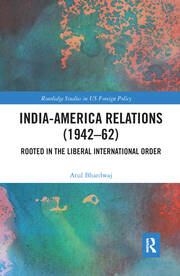
1st Edition
India-America Relations (1942-62) Rooted in the Liberal International Order
Chapter-1 – Introduction
The American Century and India
The British Invite America to India
In Awe of America
Bretton Woods and Bombay Plan
The Postwar Parting
Chapters
Conclusion
Chapter – 2 -Direct American Involvement in India
American GIs in India
Censorship and Turf war
British Propaganda Machinery in America
Networking with the Indian Elite
Airlifting Pandit
The Drew Pearson Affair
Mathai the Mole
The Economics of War
India and the Lend–Lease
American Silver for India
Conclusion
Chapter – 3 - The New Deal – Indian Planning and Politics
The Pre-war Ideas
The Post-war Package
American Inspiration for Indian Planning
TVA and Damodar Valley Project
America in Indian Rural Sector
The Peace Corps
The Appleby Pill
Mapping Indian Minerals
Indian Socialists and America
The Liberterian Returns from Brussels
JP Narayan, the Most Trusted Ally of America
Conclusion
Chapter – 4 - American Philanthropy in India
Bateson’s Advice
Early Engagement with Rockefeller Foundation
The Postwar Philanthropy in India
The Ford Foundation
Penetrating Indian Education
The American Institute of Indian Studies
The Asia Foundation
Two Tiny but Influential American NGOs
CARE
Meals for Millions
Conclusion
Chapter – 5- Diplomatic Encounters: Asymmetric Proximity
Wheat, Weapons and Wealth
Nehru’s Maiden Visit to USA
Why no FCN Treaty for India?
The Myth of Rift
Asymmetry and Proximity
Nuclear Cooperation
The American Aid Arrives
The Kennedy-Cooper Resolution
Conclusion
Chapter 6- From Tibet Towards War
The Tibet Entanglement
Tibet Lobby in India
Ike in India
Conclusion
Chapter 7 - 1962 War and the Sino-Soviet Split
India, a Credible Neutral in Korean Crisis
Nehru’s China policy in conformity with British Commonwealth
India’s not alone in recognizing China
Why Nehru did not intervene in Tibet
Rejecting the American offer of Security Council Seat
Bandung and Beyond
Non-Alignment and the Sino-Soviet Split
American Strategy to Counter the Non-Communist Neutrals
America and India’s Relations with the Soviet Union
Coming Closer to the Soviets for Domestic Political Reasons
The War and the Sino- Soviet Split
Krishna Menon – The Fall Guy
Conclusion
Biography
Atul Bhardwaj is a strategic affairs and international affairs analyst. He writes a regular column on strategy in Economic and Political Weekly. He is currently an Adjunct Fellow with the Institute of Chinese Studies (ICS), New Delhi. He has a Ph.D. in history from Ambedkar University, Delhi. He is a former Indian Navy officer, holds a graduate degree from National Defence Academy (NDA) Pune and a master’s degree in war studies from King’s College, London. He has been a Senior Fellow, Indian Council of Social Science Research and Research Fellow at the Institute of Defence Studies and Analyses New Delhi.
