




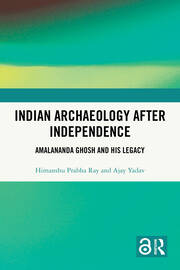
1st Edition
Indian Archaeology After Independence Amalananda Ghosh and His Legacy
1. Introduction: The Search for India’s Past 2. Deconstructing Colonial Archaeology 3. Amalananda Ghosh as Director General (1953 – 1968) 4. Search for the Lost Harappans: Bikaner Diaries 5. Ghosh and the Bikaner Survey: The Archaeologist’s Craft 6. The Present over the Past: Changing Archaeological Landscapes 7. Archaeology and Buddhism: Beyond Alexander Cunningham 8. Establishing pan-Asian archaeology 9. Monuments and Archaeological Sites: From Cultural Heritage to Tourism
Biography
Himanshu Prabha Ray is Tagore National Fellow at the School of Arts and Aesthetics, Jawaharlal Nehru University, India. After teaching at the Centre for Historical Studies, Jawaharlal Nehru University, she was appointed the first Chairperson of the newly established National Monuments Authority, Ministry of Culture in 2012. From 2014 to 2019 she was awarded the prestigious five-year Anneliese Maier fellowship of Humboldt Foundation, Germany and held an Honorary Professorship at the Distant Worlds Graduate School of the Ludwig Maximilian University, Munich.
Ajay Yadav is pursuing his DPhil in Arecheology at the University of Oxford, UK. He holds an MPhil degree from the Jawaharlal Nehru University. He is on study leave from the Indian Administrative Service, Government of India, which he joined in 2006. From 2019 to 2022 he held official positions in the Ministry of Culture and the ASI.
