




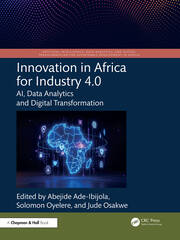
1st Edition
Innovation in Africa for Industry 4.0 AI, Data Analytics and Digital Transformation
Part I: Foundations of the Fourth Industrial Revolution
Chapter 1: Promoting Awareness of the Negative Impacts of Child Marriage through the use of Digital Technologies: Findings from Key Stakeholders
Lovisa Jennifer Nelongo, Prof. Gloria E Iyawa
Chapter 2: Blockchain Technology in Green Bond Issuance
Sikhumbuzo Sabelo Dlamini, Frank Mhando, Marwa Nyankomo
Chapter 3: A Digital Governance Framework for Public Enterprise: A Case of the Motor Vehicle Accident Fund in Namibia
Lydia Maruwasa, Suama Hamunyela, Ambrose Agbon Azeta
Chapter 4: The Integration of Lean with Industrial Revolution 4.0 Technologies for Sustainability in Food and Beverages Companies
Ahmed Bawa, Muslim Diekola Akanmu
Part II: Artificial Intelligence Across Sectors
Chapter 5: A Systematic Review of Payload Systems for Drone-Based Agriculture: Enhancing Efficiency in Precision Farming
Aluwani Cedwyn Tshishonga, Chunling Du, Professor Pius Adewale Owolawi
Chapter 6: AI Revolution in Higher Education: A Systematic Review of Transformative Tools and Technologies
Gabriel Tuhafeni Nhinda, Josephina Mikka-Muntuumo, Hedvig Mendonca, Jude Osakwe
Chapter 7: Machine Translation for code-switching between English and Setswana in a South African classroom: Some initial results
Keneilwe Mokoka, Dr Michael Olusanya, Dr Olumuyiwa Otegbeye
Chapter 8: Enhancing Data Analytics Education through Project-Based Learning: Bridging Theory and Practice
Nkosikhona Theoren Msweli
Chapter 9: Utilization of Machine Learning Algorithms for Player Classification and Prediction Analysis in Cybersecurity Games: A Case Study with CyberVigilance
Mike Wa Nkongolo, Jahrad Sewnath
Chapter 10: A Framework for Anomaly Detection of Internet Network Traffic in University Campus Using Artificial Intelligence
Ambrose Agbon Azeta, Patrick Omote, Suama Hamunyela, Edward Chimba
Chapter 11: Comparative Analysis of Machine Learning Techniques in Predicting Monkeypox
Zvinodashe Revesai, Kudakwashe Maguraushe, Belinda Ndlovu, Sibusisiwe Dube
Chapter 12: Understanding Human Behavior in Cybersecurity: Integrating Behavioral Theories into Policy Implementation and compliance
Iyaloo Ndapandula Waiganjo, Jude Osakwe, Ambrose Agbon Azeta
Chapter 13: Co-design of Entrepreneurial Digital Technology for Indigenous Communities: A Systematic Literature Review
Albertina Shilongo, Tania Prinsloo, Machdel Matthee
Part III: Immersive and Cognitive Technologies
Chapter 14: The use of virtual reality (VR) to enhance teaching and learning in undergraduate engineering classrooms
Naadhira Seedat, Rishen Roopchund
Chapter 15: Augmented Reality Application in Teaching ObjectOriented Programming Concept
Rafael Rodríguez-Puentes, Mulanduleni Niilungu
Chapter 16: A Neuroethical Analysis of AI-driven Human Function Regulation with Brain Chip Implants: A Comprehensive Review
Aliyah Veipi, Tania Prinsloo
Part IV: Data, Infrastructure and Risk Management
Chapter 17: Integrating Digital Forensics into Financial Audits for Sustainability
Ericky Iipumbu,
Chapter 18: Genetic Algorithm Optimization for A Hybrid CNN-LSTM IoT Networks
Roseline Oluwaseun Ogundokun, Elizabeth Mkoba, Christiana Oluwakemi Abikoye, Dr. Babalola Hakeem Akande, Akinbowale Nathaniel Babatunde, Ezekiel Adebayo Ogundepo, Joseph Bamidele Awotunde
Chapter 19: A Real-Time Sensor Network for Greenhouse Environmental Monitoring
Abdool Sattar Cassim, Kondwani Chafulumira Chumachiyenda Mwale, Rethabile Kgolobe, Emmanuel Igumbor, Mbolahasina Ralijaona, Simon Henry Connell, Charis Harley, Michael Rudolph
Chapter 20: Decoding NoSQL: Comparative Analysis of ArangoDB, Cassandra, and MongoDB Query Languages and Their Algebraic Structure
Josephina Muntuumo
Chapter 21: Investigating the Techniques for Securing Electronic Health Data Privacy
Hloaele Gerard Komete, Fungai Bhunu Shava, Mamoqenelo Morolong
Chapter 22: A Framework for Integrating Information Technology Risk Management into Enterprise Risk Management in Namibian Universities
Josef Natangwe Ilonga, Gundu Tapiwa
Chapter 23: Technology Adoption Impact on Environmental and Social Performance in South African Mining
Morathi Simon Mporetji, Lebogang Mosupye-Semenya
Part V: Emerging Applications & Case Studies
Chapter 24: Enhanced Stability of Drones Using Optimized PID Control Systems
Thembelihle Elizabeth Mncube, Puis Owolawi, Chunling Du
Chapter 25: Extreme Value Theory – An Application to the US Ethereum Market
Oluwaseyi Ebenezer Olalere,Nyankomo Marwa
Chapter 26: Modelling Exchange Rate of South African ZAR With Deep Learning Models
Olumide Sunday Adesina, Lawrence Ogechukwu Obokoh
Chapter 27: Emerging market sentiment towards Central Bank digital currencies (CBDCs) – contrasting lexical and machine learning approaches
Zuziwe Ntsalaze, Marwa Nyankomo
Chapter 28: Advertising on Social Media: Analyzing the Key Drivers of Success for Businesses in the Khomas Region
Rubben Nambinga, Johannes Nakanyala, Rauna Nekomba
Chapter 29: Leveraging the Power of Mass Media to Cultivate a Cyber-Savvy South Africa
Errol Baloyi, Nokuthaba Sphambili, Oyena Mahlasela
Chapter 30: Parallel Data Acquisition for Investigating Private Mode Browsing in Portable and Installed Enhanced Privacy Browsers with a Case Study on Brave
Bernadino Maquita, Isaac Nhamu
Chapter 31: Combined Shock and Maintenance Approach to Reliability Evaluation
Emmanuel Ejembi, Shawulu Hunira Nggada, Ambrose A. Azeta, Ahmed Hajyasien
Chapter 32: License Plate Recognition For Traffic Violation Detection Using Advanced Image Processing And Optical Character Recognition Techniques
Ben Festus, Oladele Matthias Omotayo, Dr. Adekunle Adewale Uthman, Kehinde Monsuru Adeleke, Dr. Engr. Mrs. Temilola Morufat Adepoju, Prof. Aibinu Abiodun Musa, Prof. Ewetumo Theophilus, Mr. Fabiyi Ademola Odunayo, Dr. Mrs. Nwankpa Ngozi Nneka, Etudaiye Abdulmumuni Isah,
Surv. Gaius Olabayode Ojo, Dr. Abimbola Olunike ADEGBENJO, Goodness O. Edaogbogun
Chapter 33: Concept paper: Employing the m-factor to mitigate South Africa's carjacking and kidnapping pandemic
Richard Maliwatu, Komete Gerard Hloaele
Biography
Abejide Ade-Ibijola is an academic who exemplifies the rare ability to translate theory into practice, research into product development, and innovation into commercialization and societal impact. Through a proven record of excellence, he has demonstrated how advanced artificial intelligence research can be transformed into tangible tools, sustainable enterprises, and public-good technologies. He currently serves as Professor of Artificial Intelligence and Applications at the Johannesburg Business School (JBS), University of Johannesburg, where he leads pioneering initiatives that bridge artificial intelligence, education, and innovation for societal transformation. He is the Founder and Chairman of GRIT Lab Africa NPC, a pan-African non-profit dedicated to training young people across Africa in programming, grit, and entrepreneurship. Recognised globally as one of Africa’s leading AI scholars, Professor Ade-Ibijola is ranked number one by Google Search as Africa’s Top Professor of Artificial Intelligence. He is an NRF-rated researcher, a two-time recipient of the Vice-Chancellor’s Distinguished Awards, and his profile is decorated with over 100 awards and recognitions. In 2025, he was appointed as the resource person to ECOWAS (Economic Community of West African States) on the use of big data and AI for regional development of 15 African countries; a strategy sponsored by the World Bank.
Solomon Oyelere is an Associate Professor of Computer Science at the University of Exeter, and a leading expert in pervasive and mobile computing, computer science education and Human-centered AI. Before joining University of Exeter, he was an Associate Professor in Pervasive and Mobile Computing at Luleå University of Technology, Sweden. He has also worked as a Postdoctoral researcher in the School of Computing, University of Eastern Finland, where he was a Principal investigator on a large-scale EU, Latin American and Caribbean project for the development of smart ecosystem for learning and inclusion.
Jude Odiakaosa Osakwe is an Associate Professor in the Department of Informatics at Namibia University of Science and Technology, where he has served since November 2018. With over two decades of academic experience, Prof. Osakwe holds a PhD in Informatics and has established himself as a leading scholar in digital transformation and information systems. His research expertise spans ICT in Education, Digital Health, Big Data Analytics, Data Governance, E-Government, Business Intelligence, and Cybersecurity. He has supervised numerous postgraduate students across Honours, Masters, and Doctoral levels, demonstrating exceptional commitment to nurturing emerging scholars. Prof. Osakwe has chaired multiple International Conferences on Information Systems and Emerging Technologies.His scholarly contributions include three book chapters, over 40 peer-reviewed journal articles, and more than 60 international and national conference publications. He has examined numerous doctoral and masters theses for institutions across Africa. Prof. Osakwe coordinates the Faculty Postgraduate Seminar and serves on key research committees, actively contributing to curriculum development and community service initiatives that advance digital innovation in developing nations.
