




1st Edition
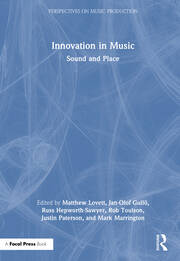
Innovation in Music Sound and Place
Part 1: Composition and Performance
1. Object-Oriented Discography: Collaboration, Creativity and the Music Hyperobject
Robert Wilsmore
2. Redividing the Octave for Expanded Tonal Spaces: Further Practical Explorations of Formalised Approaches to (Poly)Microtonal Composition
Edward Clijsen
3. Composing with waves: An empirical ontology of electromagnetism
Eleonora Oreggia
4. Spatial composition: existing concepts and new applications
Ambrose Seddon
5. Intentional Decision Making: Exploring What Improvising Composers Want Their Musical Choices to Do
Toby Armstrong
6. There is music in your noise: composition as a denoising process of experimental results
Iker Ormazabal and Iñigo Llanos
7. Emotionally Adaptive Music: Towards human composer agency in music composition with automated text/dialogue using multi-dimensional sentiment analysis
John Matthias , Nathan Duran, Giorgio Cortiana, Jamie Gibney, Jay Auborn, and Emmanuel Spinelli
8. An exploratory user study of tablature software: perspectives on popular music creativity with algorithmic tools
Baptiste Bacot, Benoît Navarret, and Louis Bigo
9. Bring Machines: Observations and Proposed Frameworks for Improvised Electronic Music Performance
Dave Fortune
10. Recasting mixed music with live electronics: towards a performance-based approach
Philippe Trovão and Henrique Portovedo
11. The Post-Musical Performer: creative and performative challenges in works for saxophone
Jorge Sousa, Henrique Portovedo, and Nádia Carvalho
12. Understanding and Emulating Time: Analyzing and Simulating Musical Microrhythm Timing with the beat_it Toolbox
Egor Polyakov
13. Evolving music theory for emerging musical languages
Emmanuel Deruty
Part 2: Case Studies
14. ‘Let the smile always be independent of nationality’: Creating Space for Migrant Voices through Participatory Art
Marieke Lewis
15. “Drunk” post-rebetiko blues: Anatomising two “dírla” intercultural songs
Nassos Polyzoidis
16. Liquidation as Quotation: Adventures in Folk Music and Deconstructive Compositional Technique
Timothy Johnston
17. Organising ‘The Croydon Concert’: How Ornette Coleman re-started his career
Nick Sorensen
18. “Let the Dance Contest Begin!”: Varying Interpretations of Metric Modulation within Chinese Man’s ‘Step Back’
Chris Inglis
19. Kokoronaki / Minimo Awarewa/ Shirarekeri / Shigitatsu Sawano / Akino Yugure: Exploring Cross-Cultural Composition and Cultural Identity
Ryoka Hagiwara
20. Let's Hear It: Unspoken Codes of Collaborative Creation in Songwriting Camps
Simon Barber and Katherine Williams
21. Creating Cross-Genre Fusions: A Practice-as-Research Approach
Kirill Polyanskiy
22. Bike Voyage II Apple: Björn J.son Lindh’s innovative flute playing in a new context
David Thyrén and Jan-Olof Gullö
23. Increasing Student Composer Diversity and Visibility: The BBC Television Programme Boarders As An Innovation Case Study
Mykaell Riley and Hussein Boon
Biography
Matthew Lovett is Head of the School of Creative Arts at Bath Spa University, UK, an award-winning creative musician and a published researcher.
Jan-Olof Gullö is Professor in Music Production, Royal College of Music, Academy of Folk Music, Jazz and Music and Media Production, Stockholm, Sweden.
Russ Hepworth-Sawyer is a mastering engineer with MOTTOsound, an Associate Professor at York St John University, UK, and the managing editor of the Perspectives on Music Production series for Routledge.
Rob Toulson is Director of RT60 Ltd, who develop innovative music applications for mobile platforms. He was formerly Professor of Creative Industries at University of Westminster and Director of the CoDE Research Institute at Anglia Ruskin University. Rob is an author and editor of many books and articles, including Drum Sound and Drum Tuning, published by Routledge in 2021.
Justin Paterson is Professor of Music Production at London College of Music in the University of West London, UK, where he leads the MA Advanced Music Technology.
Mark Marrington is an Associate Professor in Music Production at York St John University, having previously held teaching positions at Leeds College of Music and the University of Leeds. His research interests include metal music, music technology and creativity, the contemporary classical guitar and twentieth-century British classical music, and his recently published book, Recording the Classical Guitar (2021), won the 2022 ARSC Award for Excellence in Historical Recorded Sound Research (Classical Music).
