




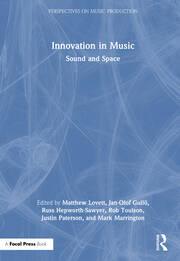
1st Edition
Innovation in Music Sound and Space
Part 1: Innovating Technological Affordance
1. Mapping Voices in Space: Sonic Portrays and Spatial Audio as Post-Acousmatic Research Methodology
Antti Sakari Saario
2. Aural Architectures and Haunted Virtualities: Rethinking Headset-based VR as a Sonic Space
Michael Trommer
3. Rethinking the Process of Audio Mixing: A Three-Stage Model for Understanding Mixing in Contemporary Record Production
Ashour Ahmed
4. Exploring the Affordances of Elektron’s Syntakt in (Electronic) Music Production and Performance with a DAW
Hussein Boon
5. Mechanical Techno in the studio: writing a track by building a kinetic sounding sculpture
Graham Dunning
6. Evaluating Gravity Well for Virtual Fader Acquisition: A Formal Study in Haptics for Audio Production
Vangelis Katsinas
7. Recording without Headphones: Past, Present, and Future
Rob Toulson, Michail Exarchos, Isaac Faraz-Chandler
8. Three innovative methods to improve the craft of music mixing
Jan-Olof Gullö, Gary Bromham, and Thomas Florén
9. Sound at Source: Instrument Modification and Machine Aesthetics
Alex Stevenson
10. (Just Like) Starting Over? What Earlier Instruments Can – and Can’t – Tell Us About Accessible Digital Musical Instruments and Disability
Mat Dalgleish and Sarah Whitfield
11. Crafting the Vibe: Innovative Vibrotactile Feedback for Blind and Visually Impaired Music Creators
Christina Karpodini and Tychonas Michailidis
12. Whose line is it anyway? A Case Study in Generative AI for Software Development: MIDI-processing Plug-in Design
Justin Paterson
13. EMMA: An Electromyographic Musical Instrument for Embodied Expression
João Coimbra, Henrique Portovedo, Luís Aly, and Sara Carvalho
Part 2: New Paradigms
14. Financial Support for non-traditional Concert Formats: an Analysis of Projects presented by Orchestras and Chamber Ensembles
Clara Colotti
15. New learning journeys are needed for contemporary audio mastering education within the UK
Russ Hepworth-Sawyer
16. Innovative Listening: Reframing our Engagement with Sound in Music Production
Mads Walther-Hansen
17. Not going back: Steps towards an ecology of musical creAItivity
Matthew Lovett
18. Generative AI as a tool to support film composition and sound design – an industry case study
Kirsten Hermes
19. Audio without a Vision: A theory of Narrative Audiobook Music
Ville Hovi and John Matthias
20. From Creative Trust to Creative Templates: How AI Transforms Musical Creativity into a Commodity in Contemporary Popular Music Production
Ruzbeh Smiley
21. Bridging the Gap: an innovative approach to increasing the effectiveness of postgraduate provision in preparing students for careers in the modern music industry
Carola Boehm, Richard Clarke, and Marc Estibeiro
22. Experiencing Uncertainty: Unlocking the Ecological Value of Quantum Computing for Musical Creativity
Yuzhen Zhu, Patrick Stacey, and Kexin Qi
23. Designerly Thinking: A New Lens To Address Contemporary Music Production Challenges
Karun Dha
24. Ancestral Virtual Sound Objects: A Decolonial Approach to Virtual Instrument Making
Diego Benalcazar Vega
Biography
Matthew Lovett is Head of the School of Creative Arts at Bath Spa University, UK, an award-winning creative musician and a published researcher.
Jan-Olof Gullö is Professor in Music Production, Royal College of Music, Academy of Folk Music, Jazz and Music and Media Production, Stockholm, Sweden.
Russ Hepworth-Sawyer is a mastering engineer with MOTTOsound, an Associate Professor at York St John University, UK, and the managing editor of the Perspectives on Music Production series for Routledge.
Rob Toulson is Director of RT60 Ltd, who develop innovative music applications for mobile platforms. He was formerly Professor of Creative Industries at University of Westminster and Director of the CoDE Research Institute at Anglia Ruskin University. Rob is an author and editor of many books and articles, including Drum Sound and Drum Tuning, published by Routledge in 2021.
Justin Paterson is Professor of Music Production at London College of Music in the University of West London, UK, where he leads the MA Advanced Music Technology.
Mark Marrington is an Associate Professor in Music Production at York St John University, UK, having previously held teaching positions at Leeds College of Music and the University of Leeds. His research interests include metal music, music technology and creativity, the contemporary classical guitar and twentieth-century British classical music, and his recently published book, Recording the Classical Guitar (2021), won the 2022 ARSC Award for Excellence in Historical Recorded Sound Research (Classical Music).
