




1st Edition
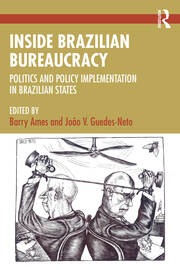
Inside Brazilian Bureaucracy Politics and Policy Implementation in Brazilian States
1. Toward a theory of policy implementation in Brazilian states 2. Bureaucrats and political bias 3. Why bureaucrats build networks 4. An agency that works: Rondônia’s Court of Accounts 5. Infrastructure and corruption: Rio de Janeiro’s Metropolitan Arc 6. Moving the people: the light rail system of Ceará 7. Conflicts over water charges in Espírito Santo's Doce River basin 8. The social organization model and the Children's Hospital in the Federal District 9. Reinventing secondary education in Minas Gerais 10. The solidarity economy program in Paraíba: coordination, capacity building, and state-society interactions 11. Troubled waters: cleaning São Paulo’s Tietê River 12. Decentralization and electoral constraints in Santa Catarina 13. Restructuring the department of transportation in São Paulo 14. Inside Brazilian bureaucracy
Biography
Barry Ames is the Andrew W. Mellon Professor of Comparative Politics Emeritus at the University of Pittsburgh. He is the author of Political Survival: Politicians and Public Policy in Latin America and The Deadlock of Democracy in Brazil; coauthor of Persuasive Peers: Social Communication and Voting in Latin America; editor of the Routledge Handbook of Brazilian Politics; and author of articles in many political science journals. He specializes in political economy, electoral systems and legislative behavior, social context and political behavior, and bureaucracy.
João V. Guedes-Neto is Assistant Professor of Public Administration at the Brazilian School of Public and Business Administration at the Getulio Vargas Foundation. His research concentrates on the individual-level dynamics of bureaucratic politics, coordination problems, the politics of policy implementation, and other aspects of intergroup relations. His work has appeared in outlets such as Comparative Political Studies, Party Politics, and Policy & Society.
This book offers a valuable contribution to understanding public policies and bureaucracy in Brazil. Through the analysis of various experiences, sectors, and states, using quantitative data and case studies, the authors present a clear portrait of Brazilian bureaucracy, emphasizing the interplay between policy and politics in Global South contexts.
Gabriela Lotta, Associate Professor of Public Administration, Fundação Getulio Vargas
Building bureaucracies that implement public policies effectively remains a key challenge for developing countries. Comparing across Brazilian state-level bureaucracies, different policy areas, and individual bureaucrats, Ames and Guedes-Neto provide a renewed theory of policy implementation. A must-read for those who seek to understand how bureaucrats navigate complex political systems.
Roberto Pires, Institute for Applied Economic Research
The originality of this book is in dealing with the intersection of the themes of federalism and bureaucracy. Both issues have gained great academic importance since the 1990s, but they are almost always seen separately. By analyzing the experience of implementing public policies in Brazilian states, the book reveals that there is no single way to govern them. The chapters reveal that there are different trajectories and styles of governance in each state, derived from a mosaic of factors. Among these, the characteristics of each public policy, the bureaucratic leadership and its alliances internal and external to the government, the action of control bodies (such as the Audit Courts and Public Ministries) and the gap between policy makers and street level bureaucracies. In a nutshell, the book opens the door to a more sophisticated and pluralistic view of the relationship between politics and public administration in the Brazilian Federation.
Fernando Luiz Abrucio, Fundação Getulio Vargas, São Paulo School of Business Administration
Brazilian bureaucracies, though known for substantial state capacity, are extremely diverse, fragmented, and ridden with contradictory pressures and attributions. In this context, public servants mobilize passions, traditions, resources and relationships, to confront a mind-boggling diversity of tasks. This book brings together a group of largely Brazilian scholars to explore why these efforts sometimes succeed and often fail. An important contribution to the literature on policy implementation and the subnational state, the book provides a rare English language guide to the entangled complexity of the Brazilian state.
Rebecca Abers, Professor of Political Science, University of Brasília
“Inside Brazilian Bureaucracy” provides a groundbreaking examination of the inner workings of state-level bureaucracies in Brazil. Drawing on rich case studies and survey data, Ames and Guedes-Neto shed light on the often-overlooked process of policy implementation, making this book essential for understanding bureaucracies, analyzing Brazilian governance, and teaching in the classroom.”
Katherine Bersch, Frontis W. Johnston Associate Professor of Political Science, Davidson College
