





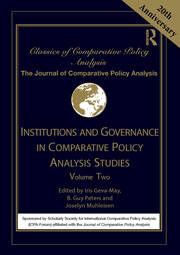
1st Edition
Institutions and Governance in Comparative Policy Analysis Studies Volume Two
Foreword
Laurence E. Lynn, Jr.
Part 1: Introduction to the Book Series and Volume Two
An Introduction: Why the Classics of Comparative Policy Analysis Studies?
Iris Geva-May, Guy B Peters, Joselyn Muhleison
Part 2: Comparative Policy Analysis, Institutions and Governance
The Rise of the Governance Mantra and Comparative Policy Analysis
Giliberto Capano
Part 3: The Classics
1. Bringing Governments Back in: Governance and Governing in Comparative Policy Analysis
Giliberto Capano, Michael Howlett, M Ramesh
2. Comparative Analyses of Infrastructure Public-Private Partnerships
Anthony E. Boardman, Carsten Greve, Graeme A. Hodge
3. Public–private partnerships in the US and Canada: "There are no free lunches"
Aidan R. Vining, Anthony E. Boardman, Finn Poschmann
4. Comparing Public–Private Partnerships and Traditional Public Procurement: Efficiency vs. Flexibility
Thomas W. Ross, Jing Yan
5. The Determinants of Privatization: a Comparative Analysis of Developing Countries
Michael Breen, David Doyle
6. Comparative Implementation Research: Directions and Dualities
Peter Hupe and Harald Saetren
7. Organizing for policy implementation: The emergence and role of implementation units in policy design and oversight
Evert Lindquist
8. Policy Harmonization: Limits and Alternatives
Giandomenico Majone
9. Exploring the Concept of Governability
Jan Kooiman
10. Can Corruption Be Measured? Comparing Global Versus Local Perceptions of Corruption in East and Southeast Asia
Min-Wei Lin, Chilik Yu
11. Public Personnel Policies: Impact on Government Performance
Greta Nasi
12. Government Effectiveness in Comparative Perspective
Soo-Young Lee, Andrew B. Whitford
13. Federalism, political structure, and public policy in the United States and Canada
Beryl A. Radin, Joan Price Boase
14. Towards Harmonization or Standardization in Governmental Accounting? The International Public Sector Accounting Standards Board Experience
Iluminada Fuertes
15. Trust and Distrust as Distinct Concepts: Why Studying Distrust in Institutions is Important
Steven Van De Walle, Frédérique Six
16. Sustainable Development and Transnational Communication: Assessing the International Influence on Subnational Policies
Sander Happaerts, Karoline Van Den Brande
17. Accountable Climate Governance: Dilemmas of Performance Management across Complex Governance Networks
Asim Zia, Christopher Koliba
18. Beyond Welfare Effort in the Measuring of Welfare States
Jon Olaskoaga, Ricardo Alaez-Aller, Pablo Diaz-De-Basurto-Uraga
19. Beyond Compliance: The Europeanization of Member States through Negative Integration and Legal Uncertainty
Susanne K. Schmidt
20. Governance in the European Union: A Policy Analysis of the Attempts to Raise Legitimacy through Civil Society Participation
Eva G. Heidbreder
21. Policy Transfer and Accession: A Comparison of Three International Governmental Organisations
Peter Carroll
22. Agency fever? Analysis of an international policy fashion
Christopher Pollit, Karen Bathgate, Janice Caulfield, Amanda Smullen, Colin Talbot
23. Networks for Regulation: Privacy Commissioners in a Changing World
Charles D. Raab
24. Four Styles of Regulation and their Implications for Comparative Policy Analysis
Christian Adam, Steffen Hurka, Christoph Knill
25. Global Governance Indices as Policy Instruments: Actionability, Transparency and Comparative Policy Analysis
Tero Erkkilä
26. Informing institutional design: Strategies for comparative cumulation
Aidan Vining, David Weimer
Biography
Iris Geva-May has been recognized by Thomson Reuters for having pioneered the field of comparative policy analysis since 1998, when she founded the now high indexed Journal of Comparative Policy Analysis. She serves as its Founding Editor. She is President of the International Comparative Policy Analysis Forum Scholarly Society. She has published among others The Logic and Methodology of Policy Analysis, An Operational Approach to Policy Analysis (with Wildavsky), International Library of Policy Analysis, Routledge Handbook of Comparative Policy Analysis, and Policy Analysis as a Clinical Profession. She is currently a Honorary Visiting Professor at SPPA, Carleton University, Ottawa, and the Wagner School NYU; and Professor Emerita, Simon Fraser University, Vancouver.
B. Guy Peters is Maurice Falk Professor of Government at the University of Pittsburgh, USA, and Honorary Editor of the Journal of Comparative Policy Analysis. He is also the Founding President of the International Public Policy Association and Editor of the International Review of Public Policy. He has been honored as the recipient of the Fred Riggs Award for Lifetime Achievement in Public Administration, and the Lifetime Achievement Award from NISPAcee. Among his seminal publications are: Comparative Politics Theory and Methods, Institutional Theory In Political Science0, The Politics of Bureaucracy: A Comparative Perspective, and An Advanced Introduction to Public Policy, The Next Public Administration.
Joselyn Muhleisen serves as the Awards Coordinator for the International Comparative Policy Analysis Forum and the Journal of Comparative Policy Analysis. She is a Doctoral Lecturer at the Marxe School of Public and International Affairs, Baruch College, City University of New York (CUNY). She earned her doctorate in political science from The Graduate Center, CUNY. She is the former Assistant Director of the European Union Studies Center, CUNY, New Yorkp. She has published work about the development of comparative policy analysis and its relationship to international studies.
