





1st Edition
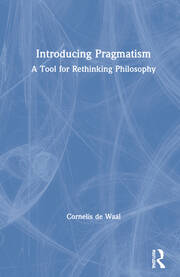
Introducing Pragmatism A Tool for Rethinking Philosophy
1. Introduction
2. Peirce and the Principle of Pragmatism
3. William James: Pragmatism and the Will to Believe
4. The Pragmatic Humanism of F.C.S. Schiller
5. European Reception I: France and Italy
6. Peirce Revisited: The Normative Turn
7. Josiah Royce and George Herbert Mead
8. Pragmatism and the Problems of Life: Dewey, Addams, and Bourne
9. Conceptual Pragmatism From Lewis to Davidson
10. The European Reception Revisited
11. The Neopragmatism of Richard Rorty
12. Hilary Putnam: Philosophy with a Human Face
13. Susan Haack: Reclaiming Pragmatism
14. Legal Pragmatism
15. Prophetic Pragmatism and Feminist Inspirations
16. Pragmatism and the End(s) of Philosophy
Biography
Cornelis de Waal is Professor of Philosophy at Indiana University–Purdue University Indianapolis and Editor-in-Chief of the Transactions of the Charles S. Peirce Society. Previously he was one of the editors of The Writings of Charles S. Peirce: A Chronological Edition. In addition to numerous journal articles, he authored Charles S. Peirce: A Guide for the Perplexed (2013) and On Mead (2002). He is currently editing The Oxford Handbook of Charles S. Peirce.
"Pragmatism is in fashion once again. However, it is not easy to explain with accuracy and clarity what pragmatism really is. Even for its founders C. S. Peirce, W. James and J. Dewey, it was not easy to define this way of doing philosophy. In recent decades the works of Hilary Putnam, Richard Rorty and Susan Haack have provided new life to this American tradition, that starts to emerge —as de Waal holds— as a philosophy focused in the future rather than the past.
In this complex field this book of Cornelius de Waal is a jewel of clarity, textual precision an intellectual finesse. This book is a must for whoever interested in knowing what pragmatism is, its history, its validity today and its fruitfulness for the culture of the 21st century. In sum, an excellent book, extremely useful for philosophers and general readers."
Jaime Nubiola, Universidad de Navarra
