




1st Edition
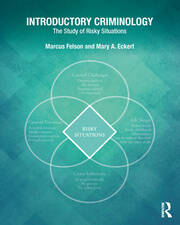
Introductory Criminology The Study of Risky Situations
Our Teaching Framework
Acknowledgments
Getting Started.
Part 1. The Crime Challenge
Unit 1.1 The Need to Control Disputes
Unit 1.2. Containing Sexual Temptations
Unit 1.3 Protecting Property
Unit 1.4 Safeguarding Children
Perspective on Part 1
Part 2. Four Types of Crime Control
Unit 2.1 Personal Controls
Unit 2.2 Social Controls
Unit 2.3 Situational Controls
Unit 2.4 Formal Controls
Perspective on Part 2
Part 3. Realistic Justice
Unit 3.l Assigning Responsibility
Unit 3.2 Realistic Policing
Unit 3.3 Realistic Court Activity
Unit 3.4 Realistic Sanctions
Unit 3.5 Efforts and Realities
Unit 3.6 Practical Crime Data
Perspective on Part 3
Part 4. Risky Ages
Unit 4.1 The Teenage Brain
Unit 4.2 Teenage Volatility
Unit 4.3 Peer Influences
Unit 4.4 Situational Inducements
Unit 4.5 Time with Peers
Perspective on Part 4
Part 5. Overt Crime Areas
Unit 5.1 Tough Neighborhoods
Unit 5.2 Cohesion vs. Intimidation
Unit 5.3 Exclusion
Unit 5.4 Concentration
Unit 5.5 Accommodation
Unit 5.6 The Pathway to Decay
Unit 5.7 Mapping Crime
Perspective on Part 5
Part 6. Risky Settings for Women
Unit 6.1 The Policy Challenge
Unit 6.2 Risky Streets
Unit 6.3 Risky Homes
Unit 6.4 Risky Nights
Perspective on Part 6
Part 7. Crime Enhancers
Unit 7.1 Crime in Groups
Unit 7.2 Crime via Cyberspace
Perspective on Part 7
Wrapping Up
Index
Biography
Marcus Felson is the originator of the routine activity approach and author of Crime and Everyday Life. He has also authored Crime and Nature, and he serves as a professor at Texas State University in San Marcos, Texas. He has a B.A. from the University of Chicago and an M.A. and Ph.D. from the University of Michigan. He has received the 2014 Honoris Causa from the Universidad Miguel Hernandez in Spain, and he has been given the Ronald Clarke Award by the Environmental Criminology and Crime Analysis group and the Paul Tappan Award by the Western Society of Criminology. He has been a guest lecturer in Argentina, Australia, Belgium, Brazil, Canada, Chile, China, Denmark, El Salvador, England, Finland, France, Germany, Hong Kong, Hungary, Italy, Japan, Mexico, the Netherlands, New Zealand, Norway, Poland, Scotland, South Africa, Spain, Sweden, and Switzerland. He has applied routine activity thinking to many topics, including theft, violence, sexual abuse, white-collar crime, and corruption. Two books honoring Professor Felson’s work have been published, one in English and another in Spanish.
Mary A. Eckert has devoted an active career to applied research in criminal justice and program evaluation. She has an M.A. and Ph.D. from New York University. Her B.A. is from the College of New Rochelle. Dr. Eckert served as Research Director of the New York City Criminal Justice Agency, Inc., where she authored many research reports and guided that agency’s diverse research agenda, including work on pretrial risk assessment, court case processing, and evaluation of alternative-to-incarceration programs. She then served in the New Jersey Office of the Attorney General, with a special focus on statistical evaluation of vehicle stops to assist the New Jersey State Police in reducing the potential for racial profiling. Her work has been recognized by the New York Association of Pretrial Service Agencies and the State of New Jersey. She has also served as an adjunct professor at New York University, Montclair State University, and Texas State University. Marcus Felson’s wife and life partner, this book is her second collaboration with her husband.
'For those looking for a fresh way to introduce students to our field, Marcus Felson and Mary Eckert have an appetizing alternative to offer. Writing in an accessible style, they bring many facts about crime together to reveal important realities. I particularly like their analysis of covert and overt crimes, and how they are affected by neighborhood poverty. They make criminology illuminating and thus interesting by exploring the visible and tangible factors that shape the nature of crime and its prevention. Indeed, I think that criminology as a field would be better off if more of us followed their lead by focusing less on ambiguous constructs and more on things we can see, touch, and change.' – Francis T. Cullen, Distinguished Research Professor Emeritus, University of Cincinnati
'From the perspective of the community college, the true intersection of our neighborhoods, Felson and Eckert have added another rich layer to criminology with risky situations. Students will be able to better retain what is taught. A solidly structured textbook that supports your pedagogy.' – Randy S. Zimpfer, Jamestown Community College
'Marcus Felson and Mary Eckert have written a cutting-edge Criminology book that breaks through the often-stuffy presentation of seemingly endless and non-related criminology theories that leave students—and instructors—hoping just to complete the semester. With an innovative framework focusing on Risky Situations, readers will clearly understand and value the connection of criminological theory with real-world and personal experiences while acquiring practical ideas to understand, prevent, and respond to crime.' – Ben Stickle, Middle Tennessee State University
