




1st Edition
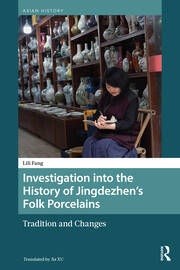
Investigation into the History of Jingdezhen’s Folk Porcelains Tradition and Changes
Introduction
Part 1. The reconstruction of tradition in the process of modernization
Chapter 1. The ecological and social environment of Jingdezhen porcelain production: Geographical distribution and change
Chapter 2. The rise and social background of the new handicraft workshops
Chapter 3. Organization of Community Businesses
Chapter 4. Fanjiajing village: The antique porcelain center
Chapter 5. Changes and reconstruction
Part 2. Thinking about tradition
Chapter 6. Porcelain trade associations in Jingdezhen
Chapter 7. Guild Halls in Jingdezhen
Chapter 8. The varieties of Jingdezhen porcelain Hangbang
Chapter 9. Summary
Part 3. The rise and decline of Jingdezhen folk kilns in the past 500 years
Chapter 10. Jingdezhen folk kilns in the early Ming dynasty: Hardship and development
Chapter 11. Jingdezhen folk kilns in the Mid-Ming period: Stable development
Chapter 12. Jingdezhen folk kilns in the late Ming period: A turning point
Chapter 13. Jingdezhen folk kiln in the early Qing period: A period of renaissance
Chapter 14. Jingdezhen folk kiln in the Mid-Qing period: Coprosperity with official kiln
Chapter 15. Jingdezhen folk kilns in the late Qing dynasty: Toward the bottom
Chapter 16. Jingdezhen folk kilns in the late Qing dynasty and the early Republic of China: Pains and gains of early Modernization
Part 4. Conclusion
Chapter 17. Beyond artistic productivity
Chapter 18. Disappearance of the empirical world
Chapter 19. Interpreting the present and looking forward to the future in terms of tradition
Afterwords
Biography
Lili Fang is Professor at the Institute of Art Anthropology, China National Academy of Arts. Her recent works include Construction of Localization in the Theory of Anthropology of Art (2023), From Production Centre to Art District: The Hyper-modern Development Model of Jingdezhen (2024), The Millennium Evolution of Jingdezhen’s Folk Kilns: Volume I (2025), The Formation and Development Toward a World Ceramic Center: Volume II (2025), The Construction and Transformation of Artisan Knowledge and Culture (2025) and Rethinking From the Soil (2025). Her book A History of Chinese Ceramics (2013) has been translated into English, Spanish and Russian.
Translator:
Jia XU is Professor of English at Beijing Institute of Technology. Her recent monographs include Shakespeare in China’s Academic Journals: A Research on Shakespearean Criticism in the Field of Foreign Literature, Theatre and Film (1949–2019) (2022) and Childhood and Coming of Age in Shakespeare’s Plays (2016). Her translated books (English to Chinese) include On Colour (2018) and DK the Shakespeare Book (2015).
