



1st Edition
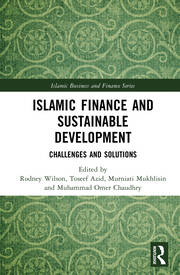
Islamic Finance and Sustainable Development Challenges and Solutions
1. Time is Running Out: Climate Emergency, Sustainable Development Goals and Islamic Epistemology Toseef Azid, Azrin Besar, Nasim S. Shirazi, and Muhammad Mahmood Shah Khan Part I: Sustainable Development and Institutions 2. The Islamic Vision of the Economy and Sustainable Development Hazik Mohamed 3. Islamic Market Institutions as The Foundation of Sustainable Development: A Conceptual Framework Mahyudin Ahmad and Sabri Nayan 4. Exploring the Synthesis of Spirituality, Economic Identity, and Social Development within the Operation of the Mosques in Scotland Fawad Khaleel 5. Similarities and Differences: How Local Politics Affects Clean Energy in Jakarta, Kuala Lumpur, and Riyadh Mustiqowati Ummul Fithriyyah 6. Digitalization, Renewable Energy and the Natural Environment: Evidence from OIC Economies Muhammad Tariq Majeed Part II: Sustainable Development and Islamic Finance 7. Financing Sustainability: Understanding Sustainable Development through Islamic Finance Abdulgafar Fahm and Hussein Abiola Ajakaiye 8.The Model of Shari’ah Contract Islamic Banking (IB) Education at The Shari’ah Financial Institutions of Higher Education N Eva Fauziah, Ifa Hanifia Senjiati and Sandy Rizjki Febriadi 9. Household Debt, Islamic Financial Institutions and Sustainability Toseef Azid, Nasim S. Shirazi, Azrin Besar, Murniati Mukhlisin and Afia Mushtaq 10. Financial Inclusion and Environmental Quality: The Role of Circular Economy and Islamic Ethics of Environment Muhammad Tariq Majeed 11.Determining Cash Waqf Models of Baitul Maal wat Tamwil and Their Roles in Achieving Triple Bottom-line Ascarya, Siti Rshmawati and Raditya Sukmana 12. Social Responsibility a Way to Recover the Role of Islamic Banking in Sustainable Development: Case Study of selected Iranian Islamic Banks Hassan Kiaee and M. Soleimani 13. Financial Soundness and Trust in Islamic Banking Relationship: Do Individualism and Uncertainty Avoidance Matter? Rochania Ayu Yunanda Part III: Sustainable Development and the Halal Industry 14. Malaysia Leads: Green Halal Hub and Dynamic Policy Challenges Leny Nofianti 15. The Future of Halal Kitchen: The Role of Solar Energy in Certified Halal Food and Beverages Industries Binti Nur Asiyah 16. Looking Ahead: Scenarios of Collaboration and Conflict in Net Zero Halal Izzum Khairun Nisa 17. Shari’ah Green Finance: Financing the Clean Energy Transition for the Halal Sector Tasriani
Biography
Rodney Wilson was a British economist and Emeritus Professor of Economics at Durham University; where he co-founded the university’s Master’s program in Islamic Finance.
Toseef Azid is a Director/Professor of Islamic Economics at Khurshid Ahmad Institute of Islamic Economics and Finance, University of Management and Technology, Lahore, Pakistan.
Murniati Mukhlisin is a Rector at Tazkia University College of Islamic Economics, Bogor, Indonesia, a team head at the Islamic Accounting Compartment at the Indonesian Institute of Accountants, and a consultant for Bank Indonesia and Financial Services Authority.
Muhammad Omer Chaudhry is a Professor of Economics and currently serving as the Vice Chancellor of Government College University, Lahore, Pakistan.
