





1st Edition
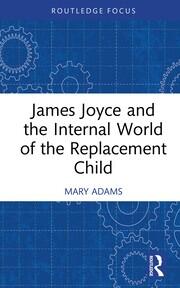
James Joyce and the Internal World of the Replacement Child
Introduction, 1. Freud. His lost brother and ‘dead mother’, 2. Images of Joyce. ‘This bizarre and wonderful creature’, 3. The ‘Dead Mother’. ‘Dark Lady’, ‘ghoul, chewer of corpses!', 4. Joyce’s Father—The Only Child. The only son of an only son of an only son, 5. Guilt and Persecution. Intrusive identification and the world of the claustrum, 6. Imagination vs Fantasy. The Ineluctability of the Proleptic Imagination, 7. Joyce: Prose Poet. Language, music and emotion, 8. Gogarty: The Lost Brother. James Joyce, ‘Buck Mulligan’ and the Martello Tower, 9. The Sorrow of Ulysses. ‘Deathflower of the potato blight on her breast.’, 10. Medievalism to Modernity. His Own Book of Kells, 11. Finnegans Wake. The Poetry of the Dream. ‘Quiet takes back her folded fields. Tranquille thanks. Adew’.
Biography
Mary Adams is a psychoanalyst working in London. She is a member of the British Psychoanalytic Association and was a training analyst for the Association of Child Psychotherapists. She worked as a psychiatric social worker in London and Boston (USA). She was Editor of The Journal of the British Association of Psychotherapists (1999-2005).
"Readers are aware that the Joyce ‘oeuvre’ is haunted by ghosts, shades, elusive and allusive fleeting asides, heaps of broken images where the ‘sun beats and the dead tree gives no shelter’. The bitterness of usurpation and betrayal stalk his pages and to the dismay of many a reader emotional passion can be obscured by his ‘catalectic tetrameter(s) of iambs marching’. But what or who haunts this vast oeuvre of James Joyce? Mary Adams unlocks the puzzle of the haunting in her theorising of ‘the replacement child’. She illuminates the harsh and lyrical linguistic landscape of Finnegans Wake, decompressing and revealing huge emotional intensity on the page. Reminding us that the unconscious is in the language not behind it! Adams gives us a deeply poignant and vivid portrait of the man, his family, his work and his world, and gives a voice to the silence around the death of Joyce’s ‘first born sibling’. She is a gifted psychoanalyst with a deep understanding of the poetry of dreams showing us how they catch and give formal representation to our passions. Her analysis gives us a heartfelt full-blooded picture of Joyce the man, the artist and genius." - Dr Paul Caviston, FRCPsych
"Mary Adams’ book is a work of Joycean scholarship, worn admirably lightly. Her love of James Joyce and his work illuminates the text. At the same time, it is a wonderfully concise, yet deeply thoughtful and moving exposition of the psychoanalytic and philosophical concepts which shape the replacement child’s internal world. The book will be of interest to analysts, child psychotherapists and lovers of James Joyce." - Hilary Lester, Training Analyst for the Society of Analytical Psychology
"In the author’s view, James Joyce is one of a surprising number of gifted writers and artists – Rilke and Van Gogh are others – who were born as ‘replacement babies’ to mothers who had lost a previous child. Drawing on her experience as a psychoanalyst, Mary Adams gives a subtle, admiring and scholarly account of Joyce’s life and work. She interprets it as his lifelong response to the painful beginning of his life and its unconscious meanings for him. Present in his work are not only memories of his family, but also of the multitude who were abandoned to die in the Irish Famine. This succinct book will encourage readers to return to Joyce’s great writings with an enriched interest." - Michael Rustin, Professor of Sociology, Associate of the British Psychoanalytical Society
"I found this book captivating and very moving. The seamless movement between Joyce the lived experience, patients and psychoanalytic texts brings each to life in a way that emphasises their connectedness, which in turn is reected in the quality and sensitivity of the writing. I felt I learnt much about the ubiquity of psychic pain and the efforts to mitigate it." - Julian Lousada, British Psychoanalytic Association
"For Joyce lovers, I expect the book to bring yet deeper understanding of the source of James Joyce’s unique and original creativity. For psychoanalysts and therapists, Adam’s book gives insight into the unconscious dynamic of the psyche of James Joyce and the hallmark characteristics of adult replacement children. The book is a great contribution for the therapeutic community and for replacement children who may feel more understood and more understanding of themselves." - Kristina Schellinski, British Journal of Psychotherapy
"This is a beautiful and thought-provoking book which will be of equal interest to both those who seek to understand the source of James Joyce’s creative genius and those who wish to better understand the internal world of patients who are born as replacement children." - Christopher Long, Journal of Child Psychotherapy
"It will be exciting to see how literary critics might incorporate this well-thought-out, highly provocative, and carefully articulated inspection of Joyce into their literary studies. By granting a window into Joyce's inner turmoil, Adams opens new avenues for exploring Joyce's work, which deviate from purely formal characteristics and enter the realm of the psychological. In her diagnosis of Joyce, Adams ultimately implores us to consider how the internal conditions of authors connect to the literature they produce to the public or, rather, to the external worlds they inhabit." - Holly Nelson, James Joyce Quarterly
"Brilliant, bold, and empathetic... Adams’ work brings clarity to much of the conundrum of Joyce’s emotional struggles, both through her passionate engagement with Joyce’s emotional life, the emotional aspects of Joyce’s characters and language experiments, and through her explanation of the ways that Joyce sought and sometimes found belonging throughout his writing career, especially at the end of his life... While her book carries us through some of the emotional struggles of Joyce’s life, especially in his fraught relationships with his parents, Adams equally considers the healing potential of reading and writing literature, not only for Joyce but also what it has likely meant for many other writers, who have carried more than their share of emotional trauma as the result of being born into their parents’ grief. I highly recommend this book to anyone interested in broadening their idea of how reading and writing literature can have a profound therapeutic effect, and also to anyone seeking new understandings of the arc of Joyce’s literary career." - Jason Parks, James Joyce LIterary Supplement
