




1st Edition
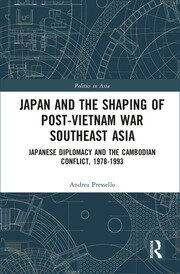
Japan and the shaping of post-Vietnam War Southeast Asia Japanese diplomacy and the Cambodian conflict, 1978-1993
By Andrea Pressello
Copyright 2018
264 Pages
1 B/W Illustrations
by
Routledge
270 Pages
1 B/W Illustrations
by
Routledge
270 Pages
1 B/W Illustrations
by
Routledge
Also available as eBook on:
The Vietnamese invasion of Cambodia in 1978 and the consequent outbreak of the Cambodian conflict brought Southeast Asia into instability and deteriorated relations between Vietnam and the subsequently established Vietnam-backed government in Cambodia on the one hand and the Association of Southeast Asian Nations (ASEAN) countries on the other. As a result of the conflict, the Soviet Union... Read more
Acknowledgments
Introduction
- Southeast Asia in Japan’s postwar foreign policy, 1950s-1960s
- US’ "exit" and Japan’s entry: post-Vietnam War Southeast Asia and the Fukuda Doctrine, 1969-1977
- The Cambodian conflict and the polarization of Southeast Asia: Japan’s response, 1978-1980
- New Cold War and Japan’s pursuit of its regional agenda, 1981-1982
- The unfolding of Japan’s "twin-track" diplomacy in Southeast Asia, 1983-1984
- Changing Cold War environment and the intensification of Japan’s peace diplomacy, 1985-1988
- The Cambodian peace process and the shaping of post-Cold War Southeast Asia: Japan’s role, 1989-1993
Conclusion
Biography
Andrea Pressello is Assistant Professor at National Graduate Institute for Policy Studies (GRIPS), Tokyo, Japan.
