




1st Edition
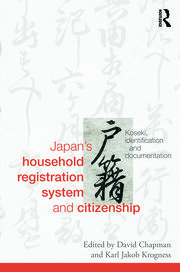
Japan’s Household Registration System and Citizenship Koseki, Identification and Documentation
1. The Koseki, David Chapman and Karl Jakob Krogness Part I: Early History 2. Early Modern Osaka Hinin and Population Registers, Takashi Tsukada 3. Household Registration and the Dismantling of Edo Outcaste Cultures, Timothy Amos 4. The Development of the Modern Koseki, Kenji Mori Part II: Nation, Empire and Occupation 5. Creating Spatial Hierarchies: The Koseki, Early International Marriage and Intermarriage, Itsuko Kamoto 6. Managing 'Strangers' and 'Undecidables': Population Registration in Meiji Japan, David Chapman 7. Sub-Nationality in the Japanese Empire: A Social History of the Koseki in Colonial Korea 1910-1945, Michael Kim 8. Blood and Country: Chūgoku Zanryū Koji, Nationality and the Koseki, Tong Yan and Shinichi Asano 9. Jus Koseki: Household Registration and Japanese Citizenship, Karl Jakob Krogness Part III: The Present 10. The Koseki and Legal Gender Change, Shūhei Ninomiya 11. Sexual Citizenship at the Intersections of Patriarchy and Heteronormativity: Same-sex Partnerships and the Koseki, Claire Maree 12. Birth Registration and the Right to have Rights: The Changing Family and Unchanging Koseki, Vera Mackie 12. Officially Invisible: The Stateless (Mukokusekisha) and the Unregistered (Mukosekisha), Tien-shi (Lara) Chen 14. Challenging the Heteronormative Family in the Koseki: Surname, Legitimacy and Unmarried Mothers, Linda White
Biography
David Chapman is Senior Lecturer and Coordinator of Japanese Studies at the University of South Australia.
Karl Jakob Krogness is Postdoctoral Researcher at the Nordic Institute of Asian Studies, Denmark.
