





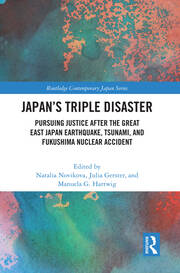
1st Edition
Japan’s Triple Disaster Pursuing Justice after the Great East Japan Earthquake, Tsunami, and Fukushima Nuclear Accident
Introduction
Natalia Novikova, Julia Gerster, and Manuela Hartwig
Part I: Nuclear Disaster and Recovery Challenges
1. Ten Years of Recovery and Revitalization Policies after the Fukushima Daiichi Nuclear Disaster
Kota Kawasaki
2. Restoring the Rights of Fukushima Nuclear Accident Victims through Collective Lawsuits
Masafumi Yokemoto
3. Voicing the Invisible: Resilience, Adaptation, and Resistance in the Narratives of the Fukushima Plaintiffs
Giulia De Togni
4. Japanese Politics and Nuclear Energy in the Ten Years since Fukushima: A Meta-Political Justice Perspective
Katsuyuki Hidaka
Part II: Dismissed Voices and Agency
5. Disasters and Domestic Violence: Making Structural Injustices toward Women after the Great East Japan Earthquake Visible
Mariko Ogawa
6. Citizenship and Disaster: Experiences of Foreign Women after 3.11
Sunhee Lee
7. The Recognition of "Death by Disaster"
Yuki Sadaike
Part III: Discredited Voices in the Credibility Economy of Disaster
8. Strategic Just-Peacebuilding and Citizen Activities after the Fukushima Daiichi Nuclear Power Plant Accident
Akiko Ishihara
9. The Right to Be Heard: Analyzing Parents’ Activism in the Kantō Region
Natalia Novikova
10. Growing up in Fukushima Prefecture after the Nuclear Accident: Young People Give Voice to the Stories of Non-Evacuated Communities
Shira Taube Dayan
Part IV: Place-making and Identity
11. Community Empowerment for a Just Recovery of Gathering Spaces: Case Studies from 3.11
Yegane Ghezelloo and Elizabeth Maly
12. Lowering Mountains, Raising Walls: Impacts of Rebuilding in Coastal Miyagi Communities
Alyne Delaney
13. From Being Seen and Heard to Feeling Displaced: The Double-Edged Sword of Tōhoku’s Post-Disaster Tourism
Anna Vainio and Annaclaudia Martini
14. The 3.11 disasters and Challenges of Pursuing Justice: Epilogue
Aya H. Kimura
Biography
Natalia Novikova is a Language Instructor at Tamagawa University, Japan. She received her Ph.D. in International and Advanced Japanese Studies at the University of Tsukuba, Japan, exploring the nature of citizen activism in the aftermath of the 3.11 disasters.
Julia Gerster is an Assistant Professor at the Disaster Culture and Digital Archive Division at the International Research Institute of Disaster Science at Tohoku University, Japan. She received a Ph.D. in Japanese studies at Freie Universität Berlin working on the role of local culture in community recovery after the Great East Japan Earthquake.
Manuela G. Hartwig is currently a research associate at the National Institute for Environmental Studies (NIES), Tsukuba, Japan. She received her Ph.D. from the University of Tsukuba in Advanced Social Japanese Studies in 2020 focusing on the role of "science advisers" in Japan’s energy and climate change policymaking network.
"Japan’s Triple Disaster is an ambitious and important book. It is unusual for bringing into dialogue the quite different constellation of issues found in the nuclear disaster and the coastal tsunami disaster. It is also unusual for its attention to a wide range of often overlooked actors: women, children, foreign residents. Anyone interested in the aftermath and memory of disaster, whether in Japan or around the world, should read this book."
Andrew Gordon, Project Director of the Japan Disasters Digital Archive (JDA), Lee and Juliet Folger Fund Professor of History, Harvard University
"This is a well- researched and sophisticated collection of smart papers that allows us to see the 2011 disasters in a new way. It is one of the best examples of detailed research that explores the aftermath of the triple disaster. Moreover, it allows us to see the complicated aspects that the disasters revealed to us as always lurking just below the surface of local and national polity. Each chapter is theoretically informed and researched with careful detail. The different facets of justice become a very productive and original way to reexamine this disaster we once thought of as familiar. I recommend this book for scholars in the field and delightfully, due to the largely jargon- free writing, it would work wonderfully for a course textbook."
David H. Slater, Professor of Cultural Anthropology, Faculty of Liberal Arts, Graduate Program in Japanese Studies, Sophia University, Tokyo
"This book addresses critical and challenging but invisible issues that should not be forgotten in disaster recovery and risk management. It is a must- read for disaster researchers and practitioners to understand injustices in disaster risk management, and gain hints to overcome them."Takako Izumi, Director, APRU Multi- Hazards Program, Professor at the International Research Institute of Disaster Science (IRIDeS)/ Graduate School of International Cultural Studies,Tohoku University, Japan
