





1st Edition
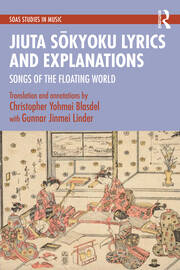
Jiuta Sōkyoku Lyrics and Explanations Songs of the Floating World
Lists of Figures
Glossary
1. Introduction
2. Introduction to the Art of Jiuta Sōkyoku
3. Aki no Koto no Ha秋の言の葉
4. Aki no Kyoku 秋の曲
5. Akikaze no Kyoku 秋風の曲
6. Azuma-jishi 吾妻獅子
7. Chaondo 茶音頭
8. Chidori no Kyoku 千鳥の曲
9. Chikubushima 竹生島
10. Chiyo no Uguisu 千代の鶯
11. Chōgonka no Kyoku 長恨歌の曲
12. Echigo-jishi 越後獅子
13. Enoshima no Kyoku 江ノ島の曲
14. Fune no Yume 舟の夢
15. Fuyu no Kyoku 冬の曲
16. Godan-ginuta 五段砧
17. Hagi no Tsuyu 萩の露
18. Haru no Kyoku 春の曲
19. Hototogisu ほととぎす
20. Imakomachi 今小町
21 Iso Chidori 磯千鳥
22 Kaede no Hana楓の花
23 Kaji Makura楫枕
24 Katsura O 桂男
25 Keshi no Hana けしの花
26 Kogō no Kyoku 小督の曲
27 Konkai こんかい(狐今、吼噦)
28 Kotobuki Kurabe 寿くらべ
29 Kurokami 黒髪
30 Kyoku Nezumi 曲鼠
31 Mama no Kawa ままの川
32 Matsukaze 松風
33 Meiji Shōchikubai 明治松竹梅
34 Mitsu no Keshiki 三つの景色
35 Mitsuyama三津山
36 Miyako no Haru 都の春
37 Miyama-jishi 御山獅子
38 Nanakomachi 七小町
39 Nasuno 那須野
40 Natsu no Kyoku 夏の曲
41 Nebiki no Matsu 根曳の松
42 Onoe no Matsu 尾上の松
43 Ōmi Hakkei 近江八景
44 Ōuchiyama 大内山
45 Saga no Aki 嵯峨の秋
46 Saigyō-zakura 西行桜
47 Sakura-gari 桜狩
48 Sakura-gawa 桜川
49 Sasa no Tsuyu 笹の露
50 Shiki no Nagame 四季の眺
51 Shin Aoyagi 新青柳
52 Shin Musume Dōjōji 新娘道成寺
53 Shin Takasago 新高砂
54 Shōchikubai 松竹梅
55 Sono no Aki 園の秋
56 Sue no Chigiri 末の契
57 Suma no Arashi 須磨の嵐
58 Sumiyoshi 住吉
59 Tama no Utena 玉の台
60 Tama-gawa 玉川
61 Tōru融
62 Tsuru no Koe 鶴の声
63 Uji Meguri 宇治巡り
64 Ukifune 浮舟
65 Usu no Koe 臼の声
66 Wakana 若菜
67 Yachiyo-jishi 八千代獅子
68 Yaegoromo 八重衣
69 Yotsu no Tami 四つの民
70 Yoyo no Hoshi 夜々の星
71 Yūbe no Kumo 夕辺の雲
72 Yūgao夕顔
73 Yuki ゆき
74 Yuya 熊野
75 Zangetsu 残月
Bibliography
Index
Biography
Christopher Yohmei Blasdel began the shakuhachi in 1972 under legendary shakuhachi master Yamaguchi Goro, completed his MA in ethnomusicology from Tokyo University of Arts in 1982 and received his shihan license from Yamaguchi in 1984. As a scholar and performer, Blasdel focuses both on traditional and contemporary music. He has released several CDs, shakuhachi reference books and has composed music for NHK documentaries and various films. He co-organized the Boulder World Shakuhachi Festival (1998), the Sydney World Shakuhachi Festival (2008) and was co-founder of the Prague Shakuhachi Festival. He presently lectures at University of Hawai’i and holds a fifth-degree black belt in Aikido.
Gunnar Jinmei Linder came to Japan in 1985, with a BA in philosophy and Japanology, and began studies of shakuhachi with Yamaguchi Goro. He received an MA in shakuhachi from the Traditional Music Conservatoire at Tokyo University of the Arts in 1997, and the traditional license shihan in 1998. After many years in Japan as stage and recording artist, as well as teacher of shakuhachi, he returned to his native Sweden and received a PhD in Japanology at Stockholm University in 2012 (Deconstructing Tradition in Japanese Music). In 2016 he received a diploma from the Japanese Minister of Foreign Affairs for his artistic and academic activities.
“Christopher Yohmei Blasdel gives us a handsome publication that is more than just a translation of shamisen and koto songs (jiuta sōkyoku) from 17th to 19th century Japan. For the English reader, this title adds a visual and literary appreciation to the sonic beauty of these songs. A combination of sensitive English imagery and insightful cultural commentary, its content is illustrated by a stunning series of woodblock prints related to the songs. In performance, the addition of shakuhachi (bamboo flute) enhances the aesthetic of the shamisen and koto performance. It seems therefore fitting that the author, an internationally known shakuhachi artist, enhances our understanding of these songs through this celebration of his lifelong engagement with them.”
Ricardo D. Trimillos, Ph.D., Editor of Asian Music journal, Professor Emeritus in Asian Studies and Ethnomusicology, University of Hawai'i at Mānoa
“Christopher Yohmei Blasdel deserves enormous credit for his prolonged dedicated research along with deep cultural exploration and for the clarity of presentation of such a copious amount of detailed explication of this important repertoire that has received so little attention from scholars of Japanese literature and culture. His knowledge and experience of jiuta sokyoku stems from study of and performance on shakuhachi in Japan for over fifty years. Contextualization of the genre permeates the book: in a guiding overview in Chapter 1; in a beautifully written, succinct tracing of its history and its artistic expressivity through time in Chapter 2 by Blasdel and his colleague in the shakuhachi world, Gunnar Jinmei Linder. Of fresh significance here is the rare attention given to expression of sympathy in the texts for the indentured women entertainers in the pleasure districts of Edo Japan, one of the contexts where these songs would have been heard.”
Bonnie Wade, Professor Emerita (Ethnomusicology), University of California, Berkeley and specialist in Asian musics
