





1st Edition
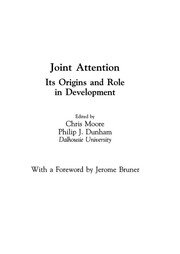
Joint Attention Its Origins and Role in Development
294 Pages
by
Psychology Press
294 Pages
by
Psychology Press
294 Pages
by
Psychology Press
Also available as eBook on:
It is perhaps no exaggeration to suggest that all of what is intrinsically human experience is grounded in its shared nature. Joint attention to objects and events in the world provides the initial means whereby infants can start to share experiences with others and negotiate shared meanings. It provides a context for the development of both knowledge about the world and about others as... Read more
Contents: Preface. J. Bruner, Foreword: From Joint Attention to the Meeting of Minds: An Introduction. P.J. Dunham, C. Moore, Current Themes in Research on Joint Attention. G. Butterworth, Origins of Mind in Perception and Action. S. Baron-Cohen, The Eye Detection Detector (EDD) and the Shared Attention Mechanism (SAM): Two Cases for Evolutionary Psychology. V. Corkum, C. Moore, Development of Joint Visual Attention in Infants. S. Desrochers, P. Morissette, M. Ricard, Two Perspectives on Pointing in Infancy. M. Tomasello, Joint Attention as Social Cognition. D.A. Baldwin, Understanding the Link Between Joint Attention and Language. P.J. Dunham, F. Dunham, Optimal Social Structures and Adaptive Infant Development. M. Sigman, C. Kasari, Joint Attention Across Contexts in Normal and Autistic Children. L.B. Adamson, D. McArthur, Joint Attention, Affect, and Culture. S.H. Landry, The Development of Joint Attention in Premature Low Birth Weight Infants: Effects of Early Medical Complications and Maternal Attention-Directing Behaviors. C.C. Raver, B.J. Leadbeater, Factors Influencing Joint Attention Between Socioeconomically Disadvantaged Adolescent Mothers and Their Infants.
Biography
Chris Moore, Philip J. Dunham, Phil Dunham
"...the editors take care to ensure their readers enter into the dialogue with a good understanding of both the topic and the aims of the book. Because of these efforts, even readers unfamiliar with this research domain will find the discussions of theory and evidence that follow to be accessible and illuminating."
—Contemporary Psychology
