




1st Edition
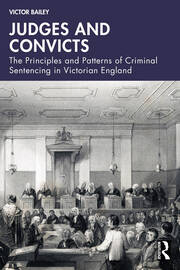
Judges and Convicts The Principles and Patterns of Criminal Sentencing in Victorian England
Introduction. 1. To Go’the Assize Circuit 2. The Criminal Courts 3. Principles of Sentencing 4. Mitigation 5. Sentencing in the Time of Transportation 6. A New Penal Equation 7. Sentencing in an Age of Panic 8. Tilt Towards Leniency 9. Abatement of Penal Servitude 10. Explaining Judicial Leniency. Envoi
Biography
Victor Bailey is the Distinguished Professor of Modern British History at the University of Kansas and Director of the Joyce and Elizabeth Hall Center for the Humanities (2000–2017). He was educated at the Centre for the Study of Social History, Warwick University, and the Institute of Criminology, Cambridge University. Among other appointments, he was a research officer at the Centre for Criminology, Oxford University, and a senior research fellow at Worcester College, Oxford. He is the author or editor of Policing and Punishment in Nineteenth Century Britain (1981; 2016), Delinquency and Citizenship: Reclaiming the Young Offender, 1914–1948 (1987), This Rash Act: Suicide Across the Life Cycle in the Victorian City (1998), Charles Booth’s Policemen: Crime, Police and Community in London (2014), The Rise and Fall of the Rehabilitative Ideal, 1895-1970 (2019), and Nineteenth-Century Crime and Punishment, vols. I to IV (2022). He was a contributor to the collection published as Protest and Survival: Essays for E.P. Thompson (1993).
