





1st Edition
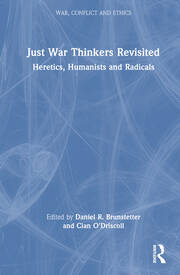
Just War Thinkers Revisited Heretics, Humanists and Radicals
Introduction: Introduction: Heretics, Humanists, and Radicals Cian O'Driscoll
1: Aristotle (384 BC–322 BC) Andree-Anne Melançon
2: Epictetus (c. 50–c. 135 AD) Luke Armstrong
3: Juan Ginés de Sepúlveda (1490–1573) Luke Glanville and David Lupher
4: Alonso de la Vera Cruz (1507–1584) Francisco Lobo
5: Martin Luther (1483–1546) Valerie Morkevičius
6: Michel de Montaigne (1533–1592) Daniel R. Brunstetter
7: John Brown (1800–1859) John Kelsay
8: Pierre-Joseph Proudhon (1809–1865) Alex Prichard
9: Carlos Calvo (1824–1906) Pablo Kalmanovitz
10: Rosa Luxemburg (1871–1919) Owen Worth
11: Luigo Sturzo (1871–1959) Gregory M. Reichberg
12: Reinhold Niebuhr (1892–1971) Eric Patterson
13: G.E.M. Anscombe (1919–2001) Chris Brown
14: Frantz Fanon (1925–1961) Gabriel Mares
15: Alasdair MacIntyre (1929–) Anthony F. Lang Jr.
16: Martin Luther King Jr. (1929–1968) Juan M. Floyd-Thomas
17: John Rawls (1921–2002) Yvonne Chiu
18: Judith Butler (1956–) Rosemary Kellison
19: Pope Francis (1936–) Christian N. Braun
20: Charles W. Mills (1951–2021) Jessica Wolfendale
Conclusion: Heretics and Humanists and Radicals, Oh My! Daniel R. Brunstetter
Biography
Daniel R. Brunstetter is Professor in Political Science at University of California, Irvine, the United States. He is the author of two books and editor of two volumes, including Just War Thinkers (2018).
Cian O’Driscoll is Professor of International Relations at the Australian National University (ANU), Canberra, Australia. He is the author of two books and editor of three volumes, including Just War Thinkers (2018).
"In an exciting break with convention, Just War Thinkers Revisited replaces the usual protagonists with an unexpected ensemble of radicals, heretics and nonconformists, whose work is often pushed to the margins or neglected altogether. Engaging with these intellectual outsiders allows the contributors to the collection to revamp tired ethical debates, reinvent accepted ethical assumptions, and reimagine settled ethical concepts."
Thomas Gregory, Lecturer in Politics and International Relations, University of Auckland, New Zealand
"A much welcome – and delightfully lyrical – disruption of entrenched categories in the Just War tradition. The authors mobilize thinkers and ideas from a broader spectrum of political philosophy than is the norm, and in so doing, they pay heed to the ethos of thinking ethically about war. The volume is a refreshing departure from endless reinterpretations of traditional texts in the understanding that these, albeit important, can take us only so far in understanding war and violence. And it is a step forward in coming to terms with the political power of the Just War tradition itself."
Elke Schwarz, Reader (Associate Professor) in Political Theory, Queen Mary University London
