




1st Edition
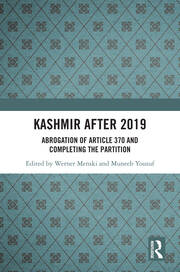
Kashmir after 2019 Abrogation of Article 370 and Completing the Partition
PART I: THE ANALYTICAL FRAMEWORK FOR DYNAMIC GENUINE PLURALISM IN ACTION
Introduction: States, Leadership, Human Suffering and the Mythologies of Azadi
Werner Menski
1. From Local Feudalism to Responsible Self-Governance: The Kashmir Kite
Werner Menski, Muneeb Yousuf
2. Flying Kashmiri Azadi Kites: Conflicts, Games or Responsible Agency?
Werner Menski, Muneeb Yousuf, Wahid Ahmad Dar, Zahoor Ahmad Wani
3. Keeping It in the Family: Understanding Kashmir as an Ancestral Property Dispute
Jawad Kadir
PART II: CONTESTED HISTORICAL AND POLITICAL ACCOUNTS: THINGS WE KNOW AND IMPORTANT LITTLE DETAILS SOME MAY NOT WANT TO KNOW
4. Feudal Kashmir, the Princely State and Beginnings of Reform Efforts
Sameer Ahmad Bhat
5. Breaking the Myth of the Accession of Jammu and Kashmir
Sheikh Javaid Ayub
6. Legal Status of Jammu and Kashmir within the Indian Union: Reading from the Texts
Ashutosh Kumar
PART III: THE TROUBLED INTERIM PHASE OF KASHMIR (1947-2019) AND CRASHING KITES OVER SOUTH ASIA
7. Continuing Problems in Kashmir during the 21st Century
Nasir Ahmad Ganaie, Muneeb Yousuf, Zahoor Ahmad Wani
8. Pakistan’s Kashmir Policy: Blocked Desires and the Search for an Honourable Exit
Muneeb Yousuf
9. India-Bangladesh Border Issues: Tidying Up the Colonial Mess
Amit Ranjan
Concluding Analysis- Post-2019 Kashmir: Completing the Partition and Facing New
Challenges
Werner Menski, Muneeb Yousuf
Biography
Werner Menski is Emeritus Professor of South Asian Laws at the School of Oriental and African Studies (SOAS), University of London, where he taught from 1981 to 2014. He developed particularly the teaching of comparative legal studies with an interdisciplinary, multidimensional South Asian focus, through courses including Legal Systems of Asia and Africa, Law and Society in South Asia and Ethnic Minorities and the Law. Apart from supervising numerous doctoral students, he published 14 books, including Muslim Family Law (with D. Pearl, 3rd edn. 1998), Modern Indian Family Law (2002, 2016), Hindu Law (2003) and Comparative Law in a Global Context: The Legal Systems of Asia and Africa (2nd edn, 2006). He has contributed almost 300 published articles, continues to be co-editor of South Asia Research and remains active in mentoring junior scholars.
Muneeb Yousuf received his PhD from the Academy of International Studies at Jamia Millia Islamia University in New Delhi. He is a Deputy Editor of South Asia Research. His research articles have been published in Studia Islamica, Contemporary South Asia and South Asia Research, among others. He also regularly writes on international affairs with a special focus on Pakistan and Kashmir and his work has appeared in Foreign Policy, The Telegraph, Al-Jazeera, The Diplomat, Frontline Magazine and several other media outlets.
