



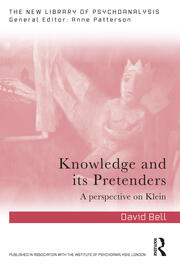
1. Unconscious phantasy: Some historical and conceptual dimensions 2. On projective identification 3. Commentary on Laplanche’s Klein 4. “One is always nearer by not keeping still”: Reflections on psychic change 5. Bion: The phenomenologist of loss 6. Some observations on the relation to reality and the function of belief in schizophrenia The Wish to Destroy 7. I am the spirit that negates all: Reflections on Freud’s death drive 8. “Civilization and Its Discontents” 9. Psychoanalytic reflections on the conditions of possibility of human destructiveness 10. The death drive: Phenomenological perspectives in contemporary Kleinian theory Concluding Chapter 11. Knowledge and its pretenders
Biography
David Bell, is a training analyst and former president of the British Psychoanalytic Society. He spent twenty-five years as a consultant psychiatrist at the Tavistock and Portman NHS Trust where he founded and led a new service for patients with long standing serious psychological disorder.
'Readers of this book will discover the deep pleasure of joining David Bell, a leading figure among contemporary London Kleinians, as he reflects upon and explores the never-ending struggle between self-deception and the search for truth that lies at the heart of psychoanalysis. His discourse into the emotional world and the workings of the human subject, framed by the writings of Freud and Klein, eschews dogma, ritual and moral assertion and exemplifies the vitality and thoughtfulness inherent in contemporary psychoanalytic theory and practice.'
Howard B. Levine, MD, Editor-in-Chief, W.R. Bion Studies Series, Editor, French Psychoanalysis: Contemporary Voices, Classical Texts
'There can be no doubt that Freud envisaged psychoanalysis as a body of theoretical knowledge that counts among the human sciences and elucidates the juncture of the inner and the outer. To a greater or lesser extent this conception has been supplanted by a reduction of psychoanalysis to a species of therapeutic instrument. David Bell's extraordinarily erudite writings represent the most remarkable attempt that I know of to reinstate and vindicate Freud's conception, extending its explanatory scope and integrating it with post-Freudian thought.'
Sebastian Gardner, Emeritus Professor of philosophy at UCL
'In this impressive two volume survey of contemporary psychoanalysis David Bell provides an account of basic Freudian concepts and their extension through the work of Melanie Klein. Firmly rooted in philosophy, and psychiatry as well as in literature and psychoanalysis he discusses difficult topics such as the nature of truth and the inevitability of human destructiveness bringing out their relevance for current social and political conflicts. The book includes chapters on psychoanalytic technique, on narcissism, on the analysis of Anna O, and on the nature of knowledge, which are designated as chiefly Freud. They are complemented in the second volume by those on projective identification, on unconscious phantasy, on the work of Bion, and on the death drive, presented a chiefly Klein. Using his extensive experience in both the psychoanalytic consulting room and the NHS clinic Bell provides an exciting new guide to these and many other psychoanalytic ideas that will be valued by both students and seasoned practitioners of psychotherapy and related professions, and indeed by anyone interested in the workings of the mind.'
John Steiner, PhD, MD, psychologist
'These papers of David Bell make a creative addition to contemporary psychoanalytic studies. His intelligent and thoughtful illumination of the work of Freud and Klein is particularly interesting and helpful, but his work also addresses a range of related subjects in an original and stimulating fashion. The breadth and depth of these papers, written in a clear and lively fashion, represents a significant contribution to our understanding of many fundamental psychoanalytic concepts.'
Dr. Michael Feldman, Distinguished Fellow, British Psychoanalytic Society
'David Bell’s extraordinary range of interests places him among that distinctive group of psychoanalysts who have always understood psychoanalysis as a theory of mind with relevance far beyond the consulting room. Like Freud, Klein, Hanna Segal, and Ronald Britton, he brings psychoanalytic thinking into dynamic engagement with culture, society, the arts, institutions, groups, politics, as well as clinical work.
Freud and Klein are the two central axes of Bell’s thought. From them, he moves outward to the most contemporary questions and then reflects back on the tradition from this sharpened, modern vantage point. His writing – like his thinking – is always alive. It invites the reader into a state of active, generative association, accompanying Bell in his restless and searching investigations into an astonishing variety of human phenomena.
I recommend these volumes most highly. They will educate you, challenge you, and – above all – revivify you.'
Francis Grier, Fellow of the British Psychoanalytic Society, Editor-in Chief International Journal of Psychoanalysis
