





1st Edition
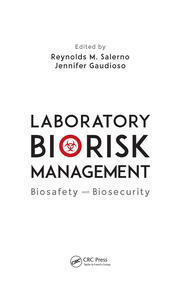
Laboratory Biorisk Management Biosafety and Biosecurity
Introduction: The Case for Biorisk Management. The AMP Model. Risk Assessment. Facility Design and Controls. Rethinking Mitigation Measures. Biorisk Management Training. Operations and Maintenance Concepts. Evaluating Biorisk Management Performance. Communication for Biorisk Management. Three Recent Case Studies: The Role of Biorisk Management. Future Development of Biorisk Management: Challenges and Opportunities.
Biography
Edited by
Reynolds M. Salerno is the senior manager for Cooperative Threat Reduction Programs at Sandia National Laboratories in Albuquerque, New Mexico. These programs enhance security by reducing biological, chemical, and nuclear threats worldwide. Reynolds M. Salerno received his PhD from Yale University. Recognized as a leading expert on laboratory biosecurity, Dr. Salerno and his Sandia team have worked extensively in laboratory biosafety, biosecurity, biocontainment, and infectious disease diagnostics and control internationally. As a technical advisor to the World Health Organization (WHO), he was a member of its international team which inspected the Maximum Containment (smallpox) Laboratory at the State Research Center of Virology and Biotechnology VECTOR in Koltsovo, Russia. He recently held the position of vice chairman of the board of directors of the International Federation of Biosafety Associations.
Jennifer Gaudioso leads the International Biological Threat Reduction and International Chemical Threat Reduction programs at Sandia National Laboratories in Albuquerque, New Mexico. These programs enhance US and international security by promoting safe, secure, and responsible use of dangerous biological and chemical agents. The team currently consults in more than 40 countries specifically on biosecurity and chemical security issues. Jennifer Gaudioso earned her PhD in chemistry from Cornell University. Dr. Gaudioso and her Sandia team work with international partners, such as the World Health Organization and the International Federation of Biosafety Associations. Dr. Gaudioso is the author of numerous journal articles and has presented her research at national and international meetings.
"Wow—what an eye-opening read on the necessity of biosafety risk management and how to successfully implement it and monitor its effectiveness. This is a great addition for any laboratory—clinical, research, other—working with any biological agent that has disproportionately hazardous adverse health effects."
—Valerie L. Ng, PhD MD, Alameda County Medical Center/Highland Hospital, writing in Doody’s Review Service
