




1st Edition
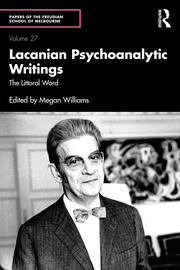
Lacanian Psychoanalytic Writings The Littoral Word
About the editor and contributors
Logos
Megan Williams
Part I: Madness
Chapter 1. Vale Rodney Kleiman (28/12/1957–23/08/2024)
David Pereira
Chapter 2. Believing in madness
Rodney Kleiman
Chapter 3. Believing in Ondine
Debbie Plastow
Chapter 4. The madness of the analyst
Peter Gunn
Part II: Disavowal … not without anxiety
Chapter 5. Lacan’s Sadean reading of jouissance
Linda Clifton
Chapter 6. Me too: I know nothing
Megan Williams
Part III: In praise of hysteria—Symposium in honour of Moustapha Safouan
Chapter 7. Introducing the work of Moustapha Safouan: a writing of letters—de lettres
Tine Nørregaard
Chapter 8. The politics of hysteria—Safouan and the question of power
Christiane Weller
Chapter 9. Why the subject is not free?
Michael Gerard Plastow
Chapter 10. For the love of Safouan: transference and identification in the Freudian school
David Pereira
Part IV: Beyond organisation—real erotics of the word
Chapter 11. A slice of the word
David Pereira
Chapter 12. Strange effects
Shubha Gokhale
Chapter 13. Of words; their substance and seductions
David Pereira
Chapter 14. Beyond the word surface: reading Beckett’s Comment c’est/How It Is as real writing
Peter Gunn
Chapter 15. Beyond the pale
Megan Williams
Chapter 16. The Winds: fragment of a possible novel
Sabina Spielrein
Part V: Translation of Ou il y a symptôme et sinthome by Jean Allouch
Chapter 17. Introduction to the translation of Où il y a symptôme et sinthome by Jean Allouch
Tine Nørregaard
Chapter 18. Ou il y a symptôme et sinthome
Jean Allouch
Chapter 19. Where there is symptom and sinthome
Jean Allouch
Part VI: Cartel on the translation of Où in y a symptôme et sinthome
Chapter 20. Introducing the cartel on the work of translation of Où il y a symptôme et sinthome by Jean Allouch
Tine Nørregaard, Michael Gerard Plastow, and Megan Williams
Chapter 21. The plus one and the intersinthomatic of transference
Tine Nørregaard
Chapter 22. Drifting
Megan Williams
Chapter 23. There is no sexual relation, and the social bond
Michael Gerard Plastow
Part VII: Melbourne Seminars of Christian Fierens 2019
Chapter 24. Introduction to four seminars by Christian Fierens
Debbie Plastow, Editor of the Fierens Papers
Chapter 25. Reality and truth
Christian Fierens
Chapter 26. Sexuality and narcissism
Christian Fierens
Chapter 27. Symptom and sinthome
Christian Fierens
Chapter 28. Enjoyment and sexual disorientation
Christian Fierens
Biography
Megan Williams is a psychoanalyst of more than 30 years’ standing, based in Australia. She is an Analyst of the School of the Freudian School of Melbourne and practises psychoanalysis in Melbourne as well as giving seminars. She has published numerous articles in psychoanalysis and has a particular interest in writing.
“The strength of the volume is that it is based in clinical practice, while remaining richly scholarly/theoretical in terms of conceptual apparatus and textual engagement. To those who ask if its ideas are practical, I would reply that clinical practice in the highly poetic field of psychoanalysis can only be enriched by the encounter with original and unabashed thinking, which sparks new energies and avenues in the reader, none of which reactions are predictable in advance, or even likely to be common among a given cohort. In this regard, the volume strikes me as eminently practical, but not in the manner of a recipe.” - Paul Magee, Professor of Poetry, Centre for Creative and Cultural Research, University of Canberra
