
1st Edition

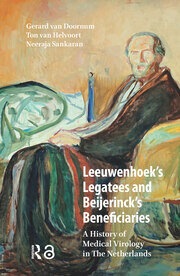
Leeuwenhoek's Legatees and Beijerinck's Beneficiaries A History of Medical Virology in The Netherlands

360 Pages
by Routledge

360 Pages
by Routledge

Leeuwenhoek’s Legatees and Beijerinck’s Beneficiaries: A History of Medical Virology in The Netherlands offers a tour of the history of Dutch medical virology. Beginning with the discovery of the first virus by Martinus Beijerinck in 1898, the authors investigate the reception and redefinition of his concept in medical circles and its implications for medical practice. The relatively slow progress... Read more
Acknowledgements, Illustrations, Abbreviations, Preface, Chapter 1, Origins in the dark: Virus diseases in the Netherlands before the discovery of viruses, Chapter 2, Redefining viruses: the development and reception of the virus concept in the Netherlands, Chapter 3, On the fringes: The Dutch work on viruses, 1900-1950, Chapter 4, From cell culture to the molecular revolution: the rise of medical virology and its organization, Chapter 5, Medical virology in the Netherlands after 1950. Laboratorries and institutes., Chapter 6, Techniques and instruments: their introduction in The Netherlands and Dutch main contributions, Chapter 7, Dutch virology in the tropics: From colonial to international virology, Chapter 8, From cancer mice in the roaring twenties to oncogenes and signalling molecules in the booming nineties, Chapter 9, Virus vaccines and immunisation programmes, Chapter 10, Conclusions, List of institutes and laboratories, References, Index of Names, Index of subjects

Biography

Gerard van Doornum is professor emeritus of Clinical Virology, Erasmus MC, Rotterdam, the Netherlands. Ton van Helvoort studied at the University of Nijmegen. His 1993 thesis (Maastricht) is entitled Research styles in virus studies in the twentieth century. As an independent historian of science, he specializes in chemistry and medicine. Neeraja Sankaran trained as microbiologist and science writer before obtaining her PhD in the history of science and medicine at Yale University with the thesis Macfarlane Burnet and the nature of the bacteriophages, 1924-1937. She currently works as independent scholar and a freelance science writer and editor.
