



1st Edition
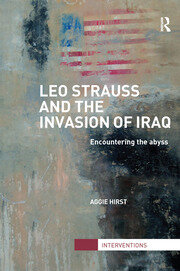
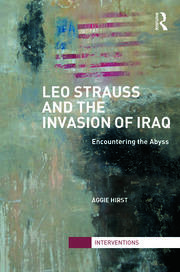
Leo Strauss and the Invasion of Iraq Encountering the Abyss
Introduction 1. The Political Philosophy of Leo Strauss 2. The Straussians 3. The Straussian Interventions and the Invasion of Iraq 4. Challenging the Straussian Interventions 5. Deconstructing the Straussian Project 6. Challenging Ontological Foreclosure in Derridean Thought Conclusion
Biography
Aggie Hirst is a Lecturer at City University London, UK.
Enthusiastically supported by the British government, the American led invasion of Iraq was as much a strategic disaster as it was an ethical and political disgrace. In Leo Strauss and the Invasion of Iraq Aggie Hirst drills down with unparalleled deconstructive skill into the intersection of thought and practice from which the war derived. There, pursuing its Straussean inflection, Hirst challenges the rules of truth that gave rise to neo-liberal truths of rule. In a debut text that offers a model for both teaching and researching into how the ways that we think impact upon the ways in which we act, Hirst assumes a leading position among a philosophically sophisticated and politically committed generation of international relations scholars.
Michael Dillon, Emeritus Professor of Politics, Lancaster University, UK.
Aggie Hirst’s insightful book does not simply retrace familiar lines of influence between the political ideas of Leo Strauss and the roles played by some of his followers in the Iraq War.By demonstrating how profoundly these interventions were informed by Strauss’ often cryptic and paradoxical philosophical response to Nietzsche’s and Heidegger’s critique of Western metaphysics, Hirst raises the debate to another level entirely, and in doing so underscores how readily politics can disrupt the most carefully crafted philosophical projects, while revealing how deeply -- perhaps inextricably – the perennial questions of philosophy remain implicated in the pivotal events of our time.
Larry George, Professor of Political Science, California State University at Long Beach, USA.
