





1st Edition
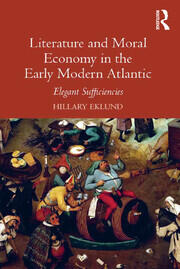
Literature and Moral Economy in the Early Modern Atlantic Elegant Sufficiencies
By Hillary Eklund
Copyright 2015
242 Pages
by
Routledge
242 Pages
by
Routledge
242 Pages
by
Routledge
Also available as eBook on:
Grounded in the literary history of early modern England, this study explores the intersection of cultural attitudes and material practices that shape the acquisition, circulation, and consumption of resources at the turn of the seventeenth century. Considering a formally diverse and ideologically rich array of texts from the period - including drama, poetry, and prose, as well as travel narrative... Read more
Part 1 Movement: Liquid agencies in Thomas Heywood's The Fair Maid of the West. Privation and policy in Shakespeare's 2 Henry VI and Coriolanus. Part 2 Improvement: Tempering temperance in Book II of The Faerie Queene. 'Expedient manage must be made': kingship and husbandry in Richard II. Part III Government: 'So great was our famine': managing plenty in Virginia. Epilogue: satis sufficit.
Biography
Hillary Eklund is Assistant Professor of English at Loyola University New Orleans, where she teaches courses on Shakespeare, Renaissance Literature, and the early modern Atlantic.
'The reader is guided to discover the connections between colonial government and profit-seeking back in England, between discourses of bodily humors and circulation of resources, and between national territorial disputes and notions of agrarian management. Harnessing Aristotle, Xenophon, and early moderns such as Erasmus or Elizabeth I in order to examine the shifting valence of "sufficiency," Eklund grounds her argument in the rich vocabulary of the day, proving how modes of discourse not only reflect but help to shape thinking about economic "progress" in the period.' Jill P. Ingram, Ohio University, USA
