




1st Edition
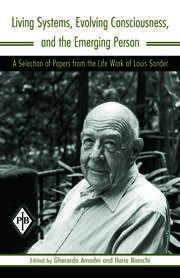
Living Systems, Evolving Consciousness, and the Emerging Person A Selection of Papers from the Life Work of Louis Sander
Biography
Louis Sander, M.D., received his medical degree at the University of California Medical School, followed by three years in the USAAF Medical Corp (1943-46), then advancing from resident in psychiatry to Professor of Psychiatry and psychoanalyst and Boston University School of Medicine (1947-68), completing his professional career as Senior Scholar and Professor of Psychiatry at University of Colorado Medical School (1979-87). His early developmental research contributions stemmed from data collected in the 25 year Boston Longitudinal Study in Early Development.
"Louis Sander is widely acknowledged as the most profound and seminal thinker among the remarkable innovators at the interface of psychoanalysis and infant development research. As he has gone on to synthesize these knowledge bases with nonlinear dynamic systems theory, he has shaped the new paradigms that have transformed the developmental-clinical landscape. This volume enables the reader to see the evolution and breadth of his stunning work. It will be an essential addition to the library of anyone who wants to understand where the infancy-psychotherapy interface is coming from, and where it will be going."
- Stephen Seligman, D.M.H., Clinical Professor of Psychiatry, Infant-Parent Program, UCSF
"It is always a great opportunity to read the collected papers of a master in his field, and to trace the development of his thinking over the course of his career. Sander's papers chronicle his fascinating studies in infant research, studies that form the basis for much contemporary thinking about human development. This book is essential reading for students of development and for clinicians interested in understanding the process of therapeutic change. In addition, the reader of this volume inevitably joins Sander in his compelling search for an integrating principle, for a way of reconciling distinctness with commonality, for a way of relating detail to the whole. Sander's writing offers sound "direction" for my own attempts to make sense of the pluralism of current psychoanalytic theories and a way to integrate my clinical experience with elegant scientific thinking."
- Alexandra Harrison, M.D., Boston Psychoanalytic Society and Institute
"Louis Sander is one of our foremost theorists of dyadic relationships, and his thinking encompasses the broad sweep of von Bertalanffy’s systems concepts and the delicacy and intricacy of intimate moments of recognition. At the heart of his work lies the dynamic tension between adaptation to the world of others and the more private struggle for self-organization, and his views continue to fuel innovative new avenues of thinking about processes of relationship. This long-overdue volume finally makes accessible the breadth of his thinking and is a much-needed companion to the new neuroscience, offering us a dynamic and systematic, but also deeply biologically grounded, view of the principles underlying our relations with one another. Every serious student of development and psychotherapy will want to be conversant with his work."
- Karlen Lyons-Ruth, Ph.D., Associate Professor, Harvard Medical School
