




1st Edition
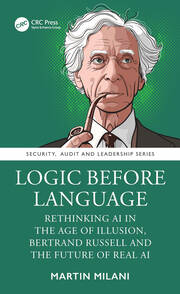
Logic Before Language Rethinking AI in the Age of Illusion, Bertrand Russell and the Future of Real AI
The book begins with Chapter One: The Illusion of Intelligence, followed by Chapter Two: The Rise of Language-Based AI, and Chapter Three: The Mirage of Meaning. Chapter Four: The Sloppiness of Speech explores the imperfections of language, while Chapter Five: Mathematics as Meaning and Chapter Six: Philosophia Mathematica delve into the mathematical foundations of reasoning. Chapter Seven: Reason Had to Be Invented examines the origins of logical thought, leading to Chapter Eight: Real-Time Reasoning and Chapter Nine: The Return of Reason, which discuss advancements in reasoning capabilities. Chapter Ten: Trustworthy Intelligence — From Black Box to Transparent Thinking addresses the need for transparency in AI systems. Chapter Eleven: From Reason to Revelation transitions into deeper insights, while Chapter Twelve: Unintelligent Intelligence critiques the limitations of current AI. Chapter Thirteen: Symbiotic Intelligence explores collaboration between humans and AI, culminating in Chapter Fourteen: The Shape of Thinking to Come, which envisions the future of intelligence and reasoning.
Biography
Martin Milani is a technology entrepreneur, CEO, CTO, strategist, and systems architect whose work spans artificial intelligence, distributed systems, internet computing, and next-generation computing. Over the course of his career, he has built and led multiple technology companies, bringing advanced computing innovations from concept to large-scale commercial deployment.
Milani’s work sits at the intersection of the boardroom and the laboratory. He is recognized for his contributions to cloud and edge computing, distributed systems, and large-scale intelligent platforms, tracing the evolution of computing from early UNIX-based systems to modern cloud architectures, microservices, and AI-driven infrastructures.
His current work focuses on the foundations of artificial intelligence, developing architectures that integrate perceptual learning, Bayesian inference, symbolic reasoning, fuzzy logic, and epistemic systems to explore how AI can move beyond statistical prediction toward systems capable of structured reasoning, real understanding, and verifiable conclusions.
Milani holds a B.S. in Computer Science with a minor in Mathematics from the University of Pittsburgh.
