





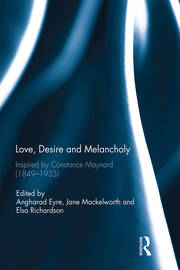
1st Edition
Love, Desire and Melancholy Inspired by Constance Maynard (1849-1935)
Introduction – Inspired by Constance Maynard: exploring women’s sexual, emotional and religious lives through their writings Jane Mackelworth, Angharad Eyre and Elsa Richardson
Part I: Constance Maynard
1. Constance Maynard’s Languages of Love Pauline Phipps
2. Love, Passion, Conversion: Constance Maynard and evangelical missionary writing Angharad Eyre
3. Religion, Same-Sex Desire, and the Imagined Geographies of Empire: the case of Constance Maynard (1849–1935) Naomi Lloyd
4. Constance Maynard’s Life-Writing Considered as Spiritual Autobiography Elisabeth Jay
5. An Exploration of Religion and Education in the Life of Constance Maynard, Mistress of Westfield College Lorraine Screene
6. ‘We Must Advance, We Must Expand’: architectural and social challenges to the domestic model at the College for Ladies at Westfield Lisa C. Robertson
Part II: Love, Friendship and Desire
7. ‘Sentimental Follies’ or ‘Instruments of Tremendous Uplift’? reconsidering women’s same-sex relationships in interwar Britain Lesley Hall
8. ‘Went into raptures’: reading emotion in the ordinary wartime diary, 1941–1946 Alison Twells
Part III: Review Essay
9. New Queer Histories: Laura Doan’s Disturbing Practices and the Constance Maynard Archive Elsa Richardson
Biography
Angharad Eyre gained her PhD in English at Queen Mary University, London, UK in 2014. Her thesis explored how the phenomenon of the woman missionary influenced nineteenth-century ideas of femininity, women’s writing and the early feminist movement.
Jane Mackelworth is finishing her PhD in History at Queen Mary University, London, UK. Her topic is ‘Writing Sapphic Love and Desire in Britain, 1900-1950’. She is also a co-convenor for the IHR History of Sexuality Seminar Series.
Elsa Richardson is a Lecturer on the history of health and medicine at the University of Strathclyde, Glasgow, UK, and completed her PhD in 2014 at Queen Mary University, London, UK. Her first monograph, Extraordinary Powers of Perception, examines the place of supernatural and prophetic forms of visionary experience in the Victorian scientific and literary imagination.
