





1st Edition
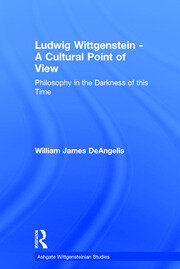
Ludwig Wittgenstein - A Cultural Point of View Philosophy in the Darkness of this Time
By William J. DeAngelis
Copyright 2007
204 Pages
by
Routledge
204 Pages
by
Routledge
204 Pages
by
Routledge
Also available as eBook on:
In the preface to his Philosophical Investigations Ludwig Wittgenstein expresses pessimism about the culture of his time and doubts as to whether his ideas would be understood in such a time: 'I make them public with doubtful feelings. It is not impossible that it should fall to the lot of this work, in its poverty and in the darkness of this time, to bring light into one brain or another - but,... Read more
Preface; Wittgenstein and “The Darkness of this Time”; Chapter 1 Spengler’s Influence on Wittgenstein: A First Approximation; Chapter 2 Wittgenstein’s Spenglerian Assessment of his Time; Chapter 3 Philosophy for a Time of Civilization: Spengler’s; Desiderata; and the; Investigations; Chapter 4 The; Investigations; as a Philosophy of Culture; Chapter 5 Religious Inexpressibility: Continuity and Change from Wittgenstein’s Early to Late Views; Chapter 6 A Religious Viewpoint in Wittgenstein’s Later Writings?; Chapter 7 Was Wittgenstein a Spenglerian Atheist?; Chapter 8 Afterword;
Biography
William J. DeAngelis is Associate Professor of Philosophy at Northeastern University, Boston, MA, USA.
’William James DeAngelis has produced a work that is careful and scholarly while at the same time very original. It guides the reader clearly and methodically to the conclusion that there are new and important questions to be asked about Wittgenstein's philosophical intentions. Having done this, he proposes resolutions to those questions. Some of these are unconventional, but all of them are plausible, interesting and very well argued. It is the first book-length discussion of a dimension of Wittgenstein's thought that has been neglected.’ John V. Canfield, University of Toronto, Canada ’DeAngelis gives us a highly spiritual, if dispirited Wittgenstein, one who expected faith to find no home in his times, but who nonetheless sought to steer us, if not in the right way, at least away from paths that only enervate and confuse.’ Heythrop Journal
